Extracts from Juan Ramírez de Lucas’s private diaries, detailing his relationship with Federico García Lorca and their plan to escape Spain, will be made public in a new documentary. The material offers new insight into the poet’s last days.
Previously unseen diaries belonging to Juan Ramírez de Lucas, the last partner of Federico García Lorca, are set to be revealed in full for the first time, according to EL PAÍS. The documents, which chronicle the couple’s secret relationship and their attempt to leave Spain before Lorca’s assassination, will be featured in the upcoming film La voz quebrada by director Manuel Menchón.
The diaries, written decades after Lorca’s death, describe the personal and social obstacles that forced the relationship into secrecy. Ramírez de Lucas, who died in 2010, explains in his notes that the weight of prejudice and taboo in Spain made it impossible to share his grief or story during his lifetime. He ultimately decided to document his memories, believing that any detail about Lorca, whom he calls “the POET,” holds historical value and should not remain hidden.
Interest in the couple’s story intensified after EL PAÍS published Lorca’s final letter to Ramírez de Lucas in 2012. The letter, dated July 18, 1936—the day the Spanish Civil War began—urged Ramírez de Lucas to remain strong and try to persuade his family to accept his choices. The publication of this correspondence led the Spanish Congress’s Culture Commission to recognize the historical significance of the archive and propose its digitization for researchers. However, the initiative stalled and was never implemented.
Director Manuel Menchón began investigating Ramírez de Lucas’s life while preparing his documentary on Lorca. After contacting the family and receiving access to additional unpublished materials, Menchón and his team spent five years researching with support from universities and historians. The result, he says, clarifies many aspects of Lorca’s final months and the circumstances surrounding his death.
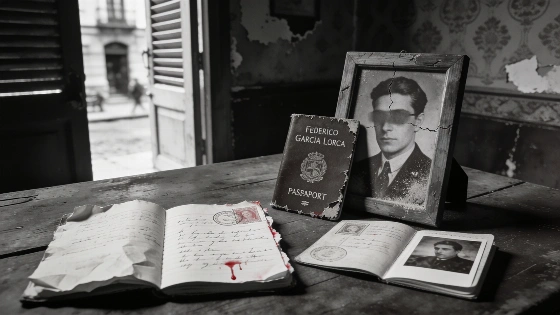
The diaries’ cover, first published by EL PAÍS in 2012, features Lorca’s name surrounded by red tears, symbolizing blood. In the summer of 1936, Lorca and Ramírez de Lucas planned to escape Spain and start anew abroad, away from the constraints of secrecy. Their plan was cut short when Lorca was killed on August 18, 1936. Nearly ninety years later, the poet’s burial site remains undiscovered, and Ramírez de Lucas lived the rest of his life carrying the pain of that loss in silence.
Menchón recounts that even those close to Ramírez de Lucas, including his colleagues, were unaware of his connection to Lorca. Throughout his life, Ramírez de Lucas kept the relationship private, never sharing the story with anyone, not even later partners. The diaries, with their emotional handwriting and candid reflections, now offer a rare glimpse into this hidden chapter of Spanish cultural history.
During research for the film, Menchón’s team also uncovered rare footage of Lorca from 1932, found in the Menéndez Pidal family archives. The restored images, showing Lorca with the theater group La Barraca, will be included in the documentary. The soundtrack features “Canción de invierno,” a piece composed by Lorca as a teenager, and actor Álvaro Morte will lend his voice to the poet and his generation, who were forced to conceal their identities.
La voz quebrada is scheduled for release in autumn. The film follows Menchón’s earlier work, Palabras para un fin del mundo, which questioned the official account of Miguel de Unamuno’s death and explored the events of October 12, 1936, at the University of Salamanca. The new documentary promises to deepen public understanding of Lorca’s final days and the enduring impact of repression on Spanish cultural figures.
Federico García Lorca remains one of Spain’s most influential poets and playwrights, whose works are studied worldwide. His assassination during the early days of the Civil War became a symbol of the era’s violence and intolerance. The release of Ramírez de Lucas’s diaries adds a personal dimension to Lorca’s legacy, highlighting the private struggles faced by those who loved him and the broader climate of fear that shaped their lives. The renewed attention to these documents may also revive calls for further research into Lorca’s disappearance and the preservation of Spain’s historical memory.