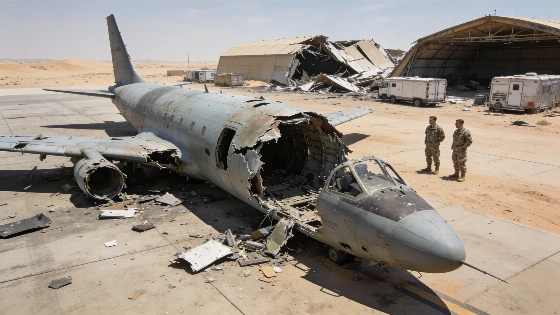
New images reveal heavy damage at US bases in the Middle East after Iranian attacks. Billions in equipment have been lost, exposing major weaknesses and fueling calls in Washington to end the conflict.
Photos obtained by CBS News show the extent of damage at US military bases in the Middle East after a series of Iranian attacks. The images, shared by active-duty personnel, capture crushed trailers, a severed radar, and ruined buildings at American installations in Saudi Arabia and Kuwait. While the photos do not have exact dates and have not been independently verified by the BBC, they match details in a recent Pentagon watchdog report that confirms widespread destruction.
One photo shows a destroyed Boeing E-3 Sentry at Prince Sultan Air Base in Saudi Arabia. The loss is notable because the E-3 is no longer made and would have to be replaced by a newer E-7, according to the Congressional Budget Office. A single E-3 costs about $500 million. The total value of lost equipment—including aircraft, drones, and a THAAD missile defense system—has reached $1.9 billion.
According to the Pentagon Inspector General, Iranian strikes damaged or destroyed hundreds of US military buildings and structures across eight countries in the region during the first four months of the conflict.
The Pentagon report, released a day before the images appeared, states that Iranian strikes have damaged or destroyed hundreds of buildings and structures at US bases in Kuwait, Bahrain, Qatar, the United Arab Emirates, Saudi Arabia, Iraq, Oman, and Jordan. The financial losses are steep: $3.7 billion in equipment and $33.4 billion in total US war spending as of June 29. Dozens of American aircraft have been destroyed or damaged since the conflict began, including five refueling planes hit on the ground in Saudi Arabia. CNN and Breaking Defense report that these numbers do not include future repair costs, and the Inspector General also notes a serious shortage in US munitions stockpiles due to ongoing operations.
Despite the scale of the damage, little information has reached the US public. A military source told CBS that Americans have not been told the full extent of the destruction. The White House referred questions to US Central Command, which has not responded.
Brian Katulis, a former national security official now at the Middle East Institute, said the images show the US was not adequately prepared to defend its bases. He also suggested that China and Russia may have helped Iran pick targets. Katulis criticized the Trump administration for not addressing these weaknesses.
Independent analyses and satellite imagery have confirmed that the US base in Bahrain, NSA Bahrain, suffered severe damage, including a strike on its command center. US Navy leadership has publicly acknowledged the seriousness of the damage, raising questions about the future of the regional headquarters.
The political response has been quick. The US House of Representatives has now voted for the third time to end the war with Iran, passing a measure that would require President Donald Trump to stop military action without congressional approval. Some Republicans supported the bill, but its fate in the Senate is unclear. On the same day, Republican Congressman Thomas Massie announced an effort to impeach Defense Secretary Pete Hegseth as new details about the war's cost emerged. The Trump administration has defended Hegseth, with Attorney General Todd Blanche calling his performance "phenomenal."
The conflict began on February 28, when the US and Israel launched joint strikes against Iran. Since then, Iran has repeatedly targeted US bases and allied countries in the Gulf, as well as Israel. The ongoing attacks have led to more scrutiny of US military strategy and spending in the region.
The scale of the damage and financial loss, along with political pressure in Washington, has forced a closer look at US defense policy in the Middle East. The lack of transparency and preparation, documented by both the Pentagon and independent analysts, raises urgent questions about the future of US operations in the region.