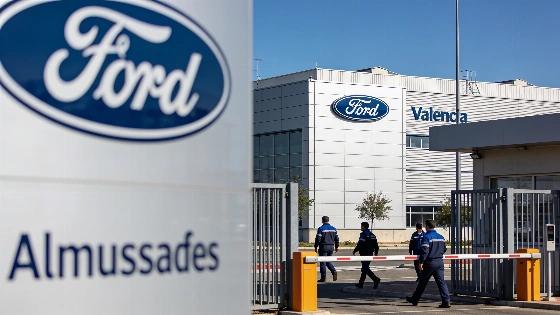
The US government has raised national security concerns over Ford’s new joint venture with China’s Geely in Valencia. The deal shifts electric vehicle production to Spain and could reshape the region’s auto industry. Washington’s warning signals rising tension over foreign technology.
Ford’s new joint venture with China’s Geely at the Almussafes plant in Valencia has drawn a direct warning from the US government. Transportation Secretary Sean P. Duffy formally cautioned Ford’s leadership that closer ties with Chinese manufacturers could threaten US national security and damage the company’s standing as a domestic partner. The Department of Transportation sent a letter to Ford CEO Jim Farley on September 3, 2026, and released its contents publicly on September 8.
The letter singles out the Almussafes agreement. Under the deal, Ford and Geely will jointly produce five new hybrid and electric models at the Spanish plant starting in 2028. The factory, which now only builds the Kuga and runs well below its 500,000-vehicle annual capacity, is expected to expand its workforce of 4,200 as production increases. Ford will control 66% of the new company, with Geely holding the remaining 34%.
The Ford-Geely joint venture in Valencia was officially announced in July 2026, with plans to launch production in 2028, not earlier as some reports suggested.
US officials argue that Ford’s use of Chinese technology and manufacturing—both in Spain and at its Michigan battery plant using CATL licenses—puts critical supply chains under foreign influence. Duffy’s letter accuses Ford of favoring overseas partnerships with "strategic competitors" instead of investing in American jobs and innovation. The message is clear: companies that deepen their reliance on China risk losing their status as trusted US partners. Reuters reports that Duffy called these ties a matter of "profound concern," specifically pointing to the Ford-Geely venture as a way for strategic competitors to enter Western markets.
For Valencia, the Ford-Geely deal could revive the Almussafes plant, which has faced years of uncertainty as Ford moved production elsewhere. The new venture is expected to bring the factory back to full capacity and secure thousands of jobs, with the first vehicles possibly rolling out in 2027 if regulators approve. Spanish officials, including Prime Minister Pedro Sánchez and regional president Juanfran Pérez Llorca, have publicly supported the project, saying it could help make Spain a center for next-generation vehicle manufacturing. Spanish media note that Ford will hold a 66% stake in the joint venture, with Geely at 34%, and the new company will take over the Almussafes plant's assets.
Chinese automakers are expanding quickly in Spain. Alongside Geely’s move in Valencia, Chery has started production in Barcelona, and SAIC Motor is preparing to open in Ferrol. CATL, the world’s largest battery maker, is building a gigafactory in Zaragoza to supply Stellantis and Leapmotor models assembled in Madrid. These investments are aimed at serving the European market while avoiding EU tariffs on Chinese imports.
The US government’s warning to Ford is currently limited to political and reputational pressure; there are no formal sanctions or legal prohibitions against the Valencia joint venture at this stage.
Reuters
Ford’s approach is not unusual. As covered in a previous investigation, cross-border industrial deals often spark political backlash when national interests are involved. The US government’s intervention in Ford’s European operations shows how global supply chains have become a battleground for influence between Washington and Beijing.
While the US frames its warning as a security issue, the situation is more complicated. Ford’s move to Spain reflects the tough economics of the electric vehicle transition: European plants offer lower costs, skilled labor, and access to a growing market. For Spain, attracting Chinese and American investment is a practical way to protect industrial jobs and modernize its auto sector. The US government’s talk of "trusted partners" is at odds with the reality that American firms are also seeking global efficiencies. The Ford-Geely deal highlights the contradictions in Western industrial policy—calling for technological independence while relying on international partnerships to stay competitive.