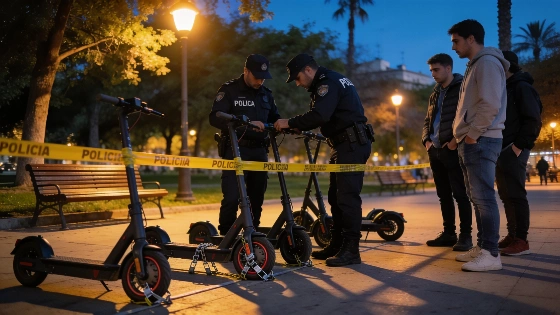
Valencia’s local police disrupted a planned mass ride of nearly 40 electric scooters. Officers issued 10 fines and immobilized eight vehicles for illegal modifications. The operation targeted risky gatherings in public spaces.
Valencia’s local police intervened on Monday evening to stop a large-scale gathering of electric scooters in Parque de Cabecera, where nearly 40 vehicles had assembled for a planned ride through the city. The operation, carried out by the municipal Group for Inspection and Surveillance of Cyclist Lanes (GIVVC), resulted in 10 fines and the immobilization of eight scooters. According to city authorities, several of the immobilized vehicles had been illegally modified to increase speed or fitted with external batteries, posing a significant risk to road safety.
The police action was prompted by concerns that such gatherings often escalate into reckless driving, illegal races, and dangerous maneuvers that endanger pedestrians. Officers inspected every scooter present at the event, which was scheduled for June 29 at 6 p.m., and focused on identifying technical alterations that violate local regulations. The city council emphasized that these interventions are part of ongoing efforts to ensure safe and regulated use of personal mobility vehicles (VMP) in Valencia.
Valencia has taken a proactive stance on micromobility, becoming the first city in Spain to launch a dedicated police unit patrolling bike lanes on scooters since February. This specialized group enforces rules for both bicycles and VMPs, conducts speed, alcohol, and drug checks, and uses advanced equipment to detect illegal e-scooters. The unit also collaborates with pedestrians and cyclists to identify and address problem areas or damage within the city’s cycling network.
Authorities report that incidents involving personal mobility vehicles have surged by 186% in Valencia between 2019 and 2023. The dedicated patrols are intended to strengthen police presence in areas where traditional vehicles face operational limits. This approach reflects a broader trend in Spanish cities to adapt to the rapid growth of e-scooters and similar vehicles, balancing the benefits of sustainable transport with the need for public safety.
Recent months have seen increased scrutiny of road safety across Spain, with several high-profile incidents drawing attention to the risks associated with both traditional and new forms of urban mobility. For example, a recent report on fatal road accidents in Castellón and Málaga highlighted the ongoing challenges faced by emergency services and authorities in managing traffic incidents. In Valencia, the focus remains on preventing dangerous gatherings and ensuring that all vehicles on public roads comply with safety standards.
Personal mobility vehicles, including electric scooters, have become increasingly popular in Spanish cities, offering a flexible alternative to cars and public transport. However, their rapid adoption has outpaced regulatory frameworks in many regions, leading to a patchwork of local rules and enforcement strategies. Valencia’s experience demonstrates both the opportunities and the challenges of integrating new mobility solutions into urban life, as authorities work to protect residents while supporting sustainable transport options.