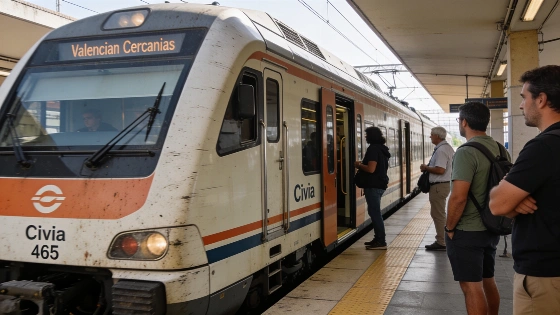
The Ministry of Transport will send 41 refurbished Civia trains from Madrid to Valencia. The move has sparked criticism over the age and condition of the units. Political parties demand a comprehensive solution for the region's rail service.
The Ministry of Transport has confirmed that 41 Civia series 465 trains, previously in service mainly around Madrid, will soon be deployed on Valencia's Cercanías network. The announcement, made by Minister Óscar Puente during a visit to Xàtiva, has triggered a sharp response from regional political groups. Both PP and Compromís have voiced strong objections, arguing that the transfer of used trains—some over two decades old—fails to address the chronic issues facing Valencia's commuter rail system.
According to the Ministry, these Civia units will replace even older rolling stock currently operating on the C-1, C-2, and C-6 lines. Officials emphasize that the Civia S465 models are the most modern available for Cercanías services, offering greater capacity with five-car formations compared to the previous three-car series 447. The trains, originally introduced between 2003 and 2012, are undergoing a full overhaul to improve passenger comfort and onboard amenities before entering service in Valencia.
Despite these assurances, opposition parties remain unconvinced. Joserra González de Zárate, PP spokesperson for Transport and Infrastructure in Les Corts, described the move as a "shame," criticizing the government for presenting the refurbishment of aging trains as a solution to persistent delays, breakdowns, and cancellations. He insisted that only a comprehensive modernization plan can resolve the region's rail problems. Compromís echoed these concerns, accusing the central government of offloading unwanted trains from Madrid to Valencia, and highlighting the need for genuine investment in the network.
The Ministry plans to have 22 of the refurbished trains running in Valencia by the end of the year, with the remaining 19 to be introduced gradually through 2027. Pere Rostoll, secretary of Infrastructure and Transport for PSPV-PSOE, defended the decision, stating that passengers will notice significant improvements once the new units are in operation. He also pointed out that previous administrations had failed to invest in new trains for the region.
Valencia's commuter rail system has long struggled with reliability and capacity issues, a situation mirrored in other parts of Spain where aging infrastructure and rolling stock have led to public frustration. The debate over the transfer of used trains highlights broader tensions between regional and central authorities regarding investment priorities. Similar disputes over transport infrastructure have surfaced elsewhere, as seen when a major accident on the AP7 caused widespread disruption and prompted calls for urgent upgrades to road safety and logistics, as reported in coverage of the AP7 traffic chaos.
Spain's Cercanías networks are vital for daily commuters, especially in metropolitan areas like Valencia. The introduction of the Civia series 465 trains is intended to provide immediate relief, but the controversy underscores ongoing demands for long-term investment and a strategic overhaul of regional rail services. The outcome of this dispute may influence future transport policy and funding decisions across the country.