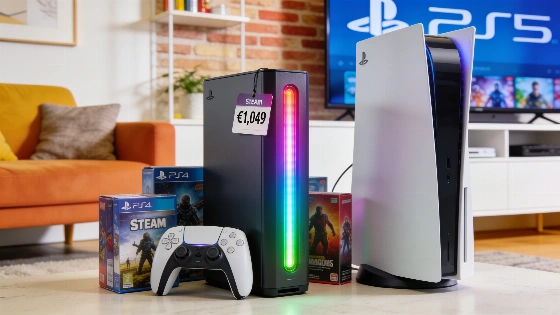
Valve has introduced the Steam Machine at a starting price of €1,049, nearly double the PS5. The device promises a vast game library and compact form, but setup issues and missing features raise questions.
Valve has officially launched the Steam Machine, positioning it as a compact, quiet alternative to traditional gaming consoles, but at a price point that significantly exceeds the PlayStation 5. The new device, which starts at €1,049 without a gamepad and €1,128 with one, is being marketed as a 'PC-plus' system, offering access to a vast game catalog and a living room-friendly design. However, early reports highlight that the Steam Machine does not deliver a clear performance advantage over Sony’s 5.5-year-old PS5, which remains available for €650.
According to The Verge, the Steam Machine’s main appeal lies in its hybrid approach: it operates like a console but retains the flexibility of a PC. Users can navigate the system entirely with a modern gamepad, and the device is notably smaller and quieter than most gaming desktops. Valve claims that the components are sold at cost, with the company negotiating directly with suppliers amid ongoing memory shortages. Despite these efforts, the high price and the need for manual configuration have become sticking points for early adopters.
Initial user experiences reveal that the Steam Machine is not yet ready to replace traditional consoles in terms of simplicity. Setup can be complicated, with issues such as incomplete game installations, missing software dependencies, and audio or display settings requiring manual adjustment. Some users have reported problems with game suspension and controller connectivity, though Valve has responded quickly to technical feedback and promises further updates.
Performance tests indicate that while the Steam Machine can handle most modern games at stable frame rates—especially when using upscaling technologies like AMD’s FSR—it struggles to match high-end gaming PCs or deliver true 4K gaming in the most demanding titles. The device supports features such as variable refresh rate (VRR), HDR, and remote game streaming, but lacks certain conveniences found in established consoles, including reliable sleep mode and automatic downloads while powered down.
Valve has confirmed upcoming improvements, including support for AMD’s FSR 4 upscaling and enhanced ray-tracing performance via driver updates. The Steam Machine also offers practical touches like magnetic faceplates and fast Ethernet connectivity. However, the company has stated it will not subsidize the device, citing its philosophy on ecosystem health, which means buyers pay standard PC prices rather than benefiting from the lower costs typical of consoles.
For those considering the Steam Machine as a full-fledged PC, the value proposition is stronger, as it can serve as both a gaming system and a desktop replacement. The device’s compact size and quiet operation may appeal to users with limited space or those seeking a dual-purpose machine. Valve has indicated that supply will be limited due to component shortages, and demand is expected to be high despite the premium price.
For context, the Steam Deck handheld, also from Valve, initially faced similar challenges but became widely recommended after a series of updates. The Steam Machine may follow a comparable trajectory, but as of now, it remains a product best suited for enthusiasts willing to navigate its early limitations. The broader gaming hardware market continues to face uncertainty, with next-generation consoles from Sony and Microsoft reportedly delayed and memory supply issues affecting pricing across the industry.
In Spain and across Europe, the Steam Machine’s launch highlights ongoing shifts in the gaming sector, where hybrid devices blur the line between consoles and PCs. As hardware shortages and rising costs persist, consumers are forced to weigh flexibility and performance against price and convenience. The Steam Machine’s reception may influence future strategies for both console makers and PC manufacturers in the region.