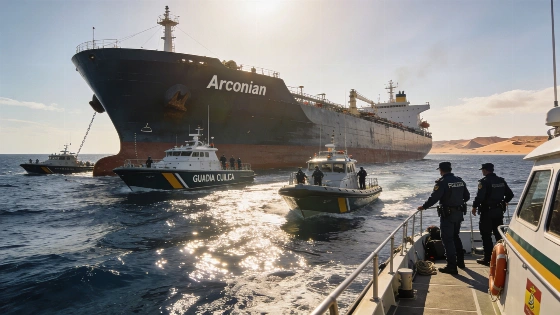
A Record 30 Tons of Cocaine Attempted to Be Smuggled into Spain on Arconian Ship. The Guardia Civil intercepted the vessel Arconian in the Atlantic with 30 tons of cocaine. The cargo was concealed and accompanied by 45,000 liters of fuel intended for drug-running boats. The operation was the largest of its kind in Spain's history.
In early May, the Guardia Civil carried out one of its largest anti-drug operations: in the Atlantic, the medium-tonnage cargo ship Arconian was detained, with a record 30 tons of cocaine found on board. According to EL PAÍS, Spain was the intended final destination of this cargo, which allowed Spanish authorities to take jurisdiction and make the arrest in international waters.
The Arconian was sailing under the flag of the Comoros Islands and departed from Freetown, the capital of Sierra Leone, on April 22. Officially, the vessel was headed for Benghazi (Libya), but its route passed near the Canary Islands. According to investigators, the ship was meant to serve as a 'mother vessel' for drug speedboats—fast boats that collect narcotics in open sea and deliver them to shore. For this purpose, the Arconian's hold contained 45,000 liters of gasoline in 30-liter canisters—the fuel was intended for refueling these boats.
Operation details
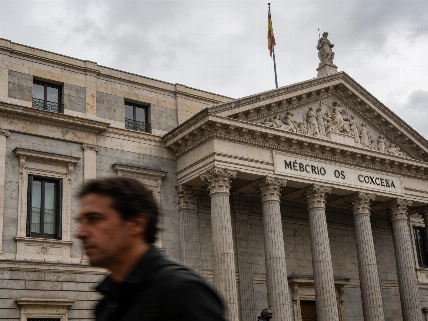
The seizure took place off the coast of Dakhla (formerly Villa Cisneros) in Western Sahara. The operation was complicated by the size of the vessel: the Arconian is over 90 meters long and about 15 meters wide. On board were 23 people, most of them Filipino nationals who were part of the crew. However, six of those detained were Dutch citizens armed with assault rifles and pistols. According to the investigation, they were responsible for guarding the cargo. All the detainees were brought before the Audiencia Nacional, where Judge Ismael Moreno remanded them in custody on charges of drug trafficking and participation in a criminal organization.
The drugs in the ship's hold were hidden behind a welded partition and distributed in approximately 1,200 bales. According to the prosecutor's office, such a quantity of cocaine had never before been seized in either Spain or the world: the previous record in Spain was 13 tons (Algeciras port, 2024), and in the US in 2019, a vessel with 20 tons was intercepted.
Links to the Mocro Maffia
Investigators suspect that the seized cargo is connected to the Mocro Maffia—a criminal network operating in the Netherlands and mainly composed of individuals from the Maghreb. Dutch authorities have also joined the investigation. Special attention is being given to Jos El Gordito (Joseph Johannes Leijdekkers), one of the most wanted drug traffickers in the Netherlands, who, according to investigators, lives in Sierra Leone and is reportedly in a relationship with the daughter of the country's president. The Arconian departed from Freetown, where he is believed to be hiding.
In recent weeks, the Guardia Civil has intercepted a ship carrying a large consignment of cocaine in this area of the Atlantic for the fourth time in a month. This confirms that the route through the waters off Western Sahara and the Canary Islands is becoming a key corridor for international drug cartels. The operation to seize the Arconian involved not only specialized Guardia Civil units but also the patrol ship Duque de Ahumada, the maritime service, and a military boat.
Legal challenges and international cooperation
The issue of jurisdiction when detaining vessels in international waters remains pressing for EU countries. Spain, according to sources in the prosecutor's office, has broad authority to take on such cases if there is a connection to its territory. However, experts emphasize that more effective coordination among European states is necessary to combat maritime drug trafficking, since most vessels sail under so-called “flags of convenience” and often lack clear national affiliation.
Large-scale operations against the drug trade continue in Spain: recently in Madrid, police seized a major shipment of MDMA and ketamine hidden inside parts of a toy tower, as reported in the article about an attempt to export drugs abroad in an unusual way. This highlights that drug cartels are using increasingly sophisticated schemes to deliver illegal substances to Europe.