José Manuel Villarejo’s lawyer claims the Kitchen case was orchestrated by Luis Bárcenas and journalists. The defense rejects allegations of a state-backed operation to seize sensitive PP files. The trial nears its conclusion.
The high-profile Kitchen case trial in Madrid took a new turn as José Manuel Villarejo’s defense directly accused Luis Bárcenas of fabricating the scandal with the help of journalists. In the final arguments before the court, Villarejo’s lawyer, Antonio García Cabrera, dismissed the prosecution’s narrative that the operation aimed to steal compromising documents from the former PP treasurer. Instead, he argued that the case was built on media manipulation and lacked solid evidence of a coordinated effort to obstruct the Gürtel investigation.
García Cabrera insisted that the operation was not a clandestine plot orchestrated by senior officials in the Ministry of the Interior or the National Police. He described it as an intelligence mission focused on tracing funds allegedly hidden by Bárcenas, not on removing sensitive files from the Partido Popular. According to the defense, the entire “Kitchen” label was a construct initiated by Bárcenas, who allegedly mobilized a group of journalists to shape public perception and create what the lawyer called a “quasi-journalistic case.”
The defense further challenged the prosecution’s assertion that the operation was designed to keep evidence out of the hands of Gürtel investigators. García Cabrera argued that the Kitchen operation and the Gürtel case were separate investigations with different objectives. He maintained that failing to inform the Gürtel team about Kitchen did not constitute a crime, as the two probes were not identical in scope or purpose.
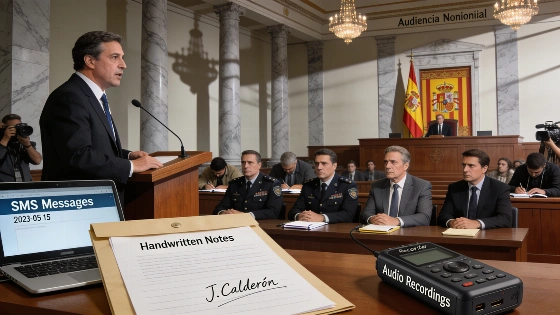
Central to the prosecution’s case are Villarejo’s own secret recordings and diary entries, which detail the recruitment of Bárcenas’s driver as a police informant and the use of reserved funds for payments. The defense sought to undermine the credibility of these materials, suggesting that the diaries could contain speculation, rumors, or strategic notes rather than factual accounts. This line of argument reflects a broader effort by defense teams to invalidate key evidence, a point that has fueled sharp debate throughout the proceedings.
During the trial, investigators highlighted the significance of Villarejo’s notes and audio files, which allegedly document efforts to locate digital files containing sensitive conversations involving senior PP figures. In one recording, Villarejo is heard urging Bárcenas’s driver to find a USB drive believed to hold compromising material. The defense, however, maintains that these actions were part of a legitimate intelligence operation authorized by Villarejo’s superiors, specifically the then Deputy Operational Director of the National Police, Eugenio Pino.
The Kitchen case has drawn intense scrutiny due to its political implications and the involvement of high-ranking officials. The prosecution is seeking a 19-year prison sentence for Villarejo, arguing that he played a central role in a state-backed scheme to obstruct justice. The trial, now in its 36th session, is approaching its final phase, with closing statements from the remaining defense teams expected imminently. Defendants will soon have the opportunity to address the court one last time before the judges deliberate on the verdict.
This case is part of a broader pattern of legal and political battles involving the Partido Popular and its former officials. For example, the role of ex-Interior Minister Jorge Fernández Díaz has also come under scrutiny, as detailed in a related report on how he has denied criminal responsibility for the Kitchen operation. More on this aspect can be found in the article examining Fernández Díaz’s defense strategy: key developments in the Fernández Díaz proceedings.
As the Kitchen trial nears its conclusion, it highlights the ongoing challenges facing Spain’s political and judicial systems in addressing allegations of corruption and abuse of power. The outcome is expected to have lasting implications for the accountability of public officials and the transparency of law enforcement operations. The case also underscores the complex interplay between politics, media, and the justice system in high-stakes investigations involving Spain’s major parties.