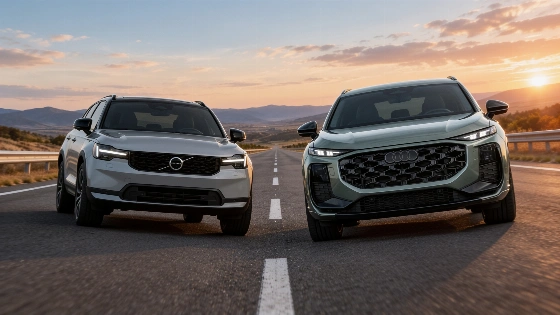
Volvo and Audi have launched their latest contenders in the luxury SUV segment. The updated XC40 and the all-new Q3 both promise electrified powertrains and advanced tech, but only one can claim the edge in Spain’s fiercely competitive market.
Numbers tell the story. Audi’s Q3 has already moved 6,701 units in Spain this year. Volvo’s XC40 trails with 4,657. Both brands want more. Their latest models are built to win over buyers who care about tech, electrification, and everyday usefulness. This is not just a badge fight. It’s a battle for the top spot in a crowded field.
The Audi Q3 comes in as a full redesign. It stretches 4.53 meters long and starts at 48,530 euros. The look is sharp. A big Singleframe grille dominates the front. At the back, the four-ring logo lights up. Inside, Audi has gone digital. Two large screens take over the dash: 11.8 inches for the cluster, 12.8 for infotainment. The cabin feels modern and high-tech. Some drivers may find it less ergonomic than the Volvo, but the wow factor is real.
По данным ANFAC, Faconauto и Ganvam, за январь–сентябрь 2026 года в Испании зарегистрировано 912 059 легковых автомобилей и внедорожников — на 6,7% больше, чем годом ранее.
Volvo sticks to its roots. The XC40’s update is subtle. New headlights, a tweaked grille, and fresh wheel designs up to 20 inches. Inside, the minimalist style stays. The vertical touchscreen grows to 11.2 inches and responds faster. Google Gemini voice assistant and wireless charging are now included. Volvo also upgraded the upholstery and trim. The result is a cabin that feels even more premium.
Space is where the two split. The XC40 gives more rear legroom. That matters for families or anyone who often has passengers. But the boot is smaller at 443 liters. Audi’s Q3 offers 488 liters, and with the sliding rear bench, it can reach 575 liters. The Q3 e-hybrid loses out here, dropping to 375 liters of cargo space.
Powertrains and equipment
Audi gives buyers more choices under the hood. There’s a 1.5-liter TFSI mild hybrid (150 CV, ECO label), two 2.0 TFSI petrols (204 and 265 CV), a plug-in hybrid e-hybrid (272 CV, up to 120 km electric range, CERO label), and two 2.0 TDI diesels (150 and 193 CV). Equipment lines include Business, Advanced, and S-Line. Buyers can add packages like Confort Visión, Confort Plus, and Premium. These bring features such as adaptive cruise and 360-degree cameras.
За девять месяцев 2026 года в Испании зарегистрировано 217 298 электрифицированных легковых автомобилей — на 36,9% больше по сравнению с прошлым годом, а их доля достигла 23,8% рынка. В сентябре полностью электрические автомобили впервые заняли второе место по популярности среди силовых установок после гибридов.
Volvo keeps it simple. The XC40 comes with a 2.0-liter turbo petrol and 48V mild hybrid tech. Buyers pick between B3 (163 CV) or B4 (197 CV). Both use a seven-speed dual-clutch automatic and front-wheel drive. There are six trim levels: Essential, Premium Essential Edition, Core, Plus, Ultra, and Top Edition Ultra. Standard kit covers lane keeping, adaptive cruise, LED headlights, and a full suite of safety tech.
Volvo has not announced the new XC40’s price yet. The outgoing model starts at 42,800 euros. It will likely come in below the Q3’s entry price. Still, Audi’s wider engine range and bigger tech leap may justify the extra cost for buyers who want the latest features.
Market impact
Sales trends are shifting. Audi’s Q3 has sold 2.7 million units worldwide since 2011. In Spain, it’s up 22.86% year-on-year. That’s strong momentum. The XC40 has been Volvo’s top seller since 2018. It’s still key for the brand. But this update is more cautious. That could limit its pull with buyers who want the newest tech.
Some buyers want comfort in the back and a simple, less flashy interface. The XC40 delivers that. Others want every powertrain option, including diesel and plug-in hybrid. The Q3 is hard to beat for variety. This matches what’s happening in other segments, as shown in recent analysis of electrified vehicle sales in Spain.
Both SUVs show where the Spanish premium market is heading. Electrification is now a must. Buyers expect comfort, tech, and efficiency. The Q3’s jump in digital features and engine choices gives it an edge for those chasing the latest and widest options. The XC40’s practical cabin and calm design will still win over fans of Scandinavian simplicity. In Spain, choice matters most. Right now, Audi’s Q3 leads the pack. But Volvo’s XC40 is still a strong pick for drivers who know what they want—and what they don’t.