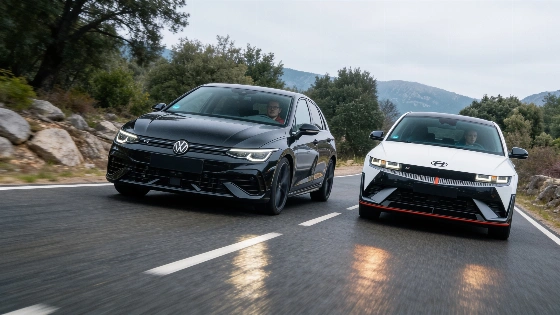
The Volkswagen Golf R and Hyundai Ioniq 5 N represent two extremes: combustion versus electric, 333 hp against 650 hp. But which car actually feels more engaging and delivers a purer driving experience? Here’s a detailed comparison.
When the Volkswagen Golf R and Hyundai Ioniq 5 N line up side by side, the numbers alone suggest an uneven match. The Golf R brings a 2.0 TSI petrol engine with 333 hp, DSG gearbox, and 4Motion all-wheel drive, while the Ioniq 5 N counters with a staggering 650 hp from dual electric motors, N Grin Boost, and an 84 kWh battery. Yet, the real story goes far beyond raw power.
On paper, the Hyundai’s output is overwhelming, but performance is not just about acceleration. The Golf R weighs in at 1,548 kg, while the Ioniq 5 N tips the scales at 2,275 kg—a difference that shapes every aspect of their character.
Weight is the enemy of performance — no amount of power can fully hide the physics of mass in a corner.
Design and Interior
Physically, these cars occupy different worlds. The Volkswagen Golf R 2026 remains a compact at 4.30 meters long, while the Hyundai Ioniq 5 N stretches to 4.72 meters with a three-meter wheelbase. Visually, the Golf R is understated, even with its quad exhausts, whereas the Ioniq 5 N flaunts 21-inch wheels, a bold diffuser, and a prominent rear wing.
Inside, the Golf R features a 10.2-inch digital cluster and a 12.9-inch central screen, though its touch sliders remain divisive. The Hyundai offers two 12.3-inch displays and more physical buttons, which many drivers may find more intuitive. Despite its dramatic look, the Ioniq 5 N’s interior doesn’t fully justify its €78,000 price tag, while the Golf R feels more cohesive and solid, if not luxurious.
Performance and Technology
The Golf R’s 2.0 TSI delivers 333 hp and 420 Nm, paired with a seven-speed DSG and torque-vectoring 4Motion. It officially sprints from 0 to 100 km/h in 4.6 seconds. The Ioniq 5 N, with its dual motors and N Grin Boost, produces 650 hp and 770 Nm, reaching 100 km/h in just 3.4 seconds. In real-world acceleration and mid-range punch, the Hyundai is simply faster, recovering from 80 to 120 km/h in 4.2 seconds versus the Golf’s 5.2.
However, the Golf R offers a more organic connection between throttle, gearbox, sound, and response. The Ioniq 5 N compensates for its lack of traditional mechanics with a suite of advanced systems: N Launch Control, N Pedal, N Race, N Drift Optimizer, N Torque Distribution, N e-Shift, and N Active Sound, all of which allow deep customization of its driving character.
Chassis and Driving Feel
This is where the weight difference becomes decisive. The Golf R’s lighter chassis translates to sharper turn-in, clearer feedback, and a more natural ability to adjust its line mid-corner. The R-Performance package adds Special and Drift modes, making the car feel alive and precise.
The Ioniq 5 N, despite its 2,275 kg mass, is impressively tuned. Its adaptive dampers and rigid structure keep body roll in check, but in quick direction changes, inertia is still noticeable. Braking hardware is robust—400 mm front discs, 360 mm rear, and four-piston calipers—but the Golf R’s pedal feel is cleaner, stopping from 100 km/h in 34.8 meters.
Efficiency, Range and Price
On a mixed route, the Golf R consumed 9.1 l/100 km (official: 8.1), while the Ioniq 5 N used 23.5 kWh/100 km. Under spirited driving, those figures rose to 10.9 liters and 33.1 kWh, respectively. Real-world range also diverges: 604 km for the Golf R, 357 km for the Ioniq 5 N, whose heavy battery limits both weight and range at higher speeds.
The Hyundai’s charging speed is a highlight—10% to 80% in just 18 minutes—but its price starts at €78,000, compared to the Golf R’s €50,730 base. The tested Golf R, fully equipped, reached €57,876, still well below the Ioniq’s €78,580. Luggage space also differs: 341 liters for the Golf, 480 for the Ioniq.
Verdict: Power or Purity?
The Hyundai Ioniq 5 N dominates in acceleration, space, power, and configurability. Transforming such a large, heavy EV into a rapid, precise, and entertaining machine is a technical feat. Yet, when it comes to pure driving enjoyment, the Volkswagen Golf R stands out. Its lighter weight, mechanical feedback, and intuitive chassis make every corner more engaging and less artificial.
For those seeking the most advanced electric performance, the Ioniq 5 N is a benchmark. But for drivers who value connection and classic sportiness, the Golf R remains the more rewarding choice. This echoes the ongoing debate in the compact segment, as seen in the recent Golf vs Astra comparison, where the balance between innovation and tradition continues to shape the market.
Looking ahead, the evolution of high-performance EVs like the Ioniq 5 N signals a shift in what enthusiasts can expect from future hot hatches. Yet, for now, the Golf R’s blend of agility, feedback, and mechanical honesty keeps it at the heart of the driving enthusiast’s conversation.