Spanish Supreme Court Allows Installation of EV Charging Stations Without Neighbors’ Consent. The Spanish Supreme Court has confirmed that installing an electric vehicle charging station in an individual parking space does not require approval from the homeowners’ association. It is sufficient to notify the community and cover all costs independently.
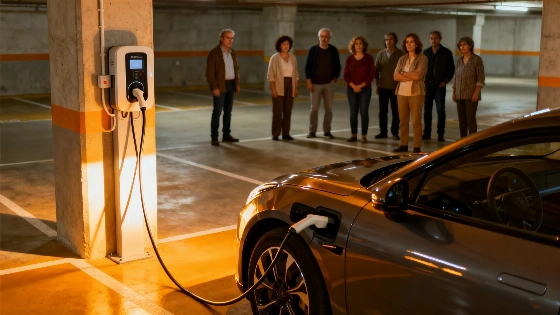
In Spain, the issue of installing charging stations for electric vehicles in shared garages has long been a source of disputes between owners and homeowners’ associations. Now the Supreme Court has settled the debate: if it concerns a private parking spot in a shared garage, the owner has the right to install a charger for their electric car without obtaining permission from neighbors. It is sufficient to notify the community in advance and bear all installation and future electricity costs.
This court decision has become an important reference point for thousands of Spaniards considering switching to electric vehicles, but who face bureaucratic hurdles and a lack of understanding from other residents. As noted by Talent24h, the Supreme Court dismissed a complaint from one such association and confirmed: requiring a vote or the consent of the majority of residents in such cases is illegal. The Law on Horizontal Property clearly states that, for installing a charger at an individual parking spot, prior notification is sufficient.
Legal requirements
According to Article 17.5 of the Law on Horizontal Property, if the charging station is intended for personal use and is placed at an individual parking spot, the owner is only required to notify the homeowners’ association in writing before starting work. All installation and electricity costs are solely the responsibility of the initiator. The association has no right to turn the notification into an approval process or require separate authorization.
In practice, this means that the owner can begin installation immediately after notifying, without waiting for a decision from the homeowners' association. The main condition is that the installation must not be collective and cannot be intended for shared use. This approach removes unnecessary administrative barriers and makes the transition to electric vehicles more accessible for residents of apartment buildings.
Permissible limits
The Supreme Court specifically emphasized: even if part of the cables or fixtures passes through common areas of the garage, this is not a reason for refusal. An exception is possible only if the work leads to excessive interference with shared elements of the building or causes real damage to other owners. Mere inconvenience or aesthetic considerations are not considered sufficient grounds for prohibition.
Thus, the homeowners' association may object only if there are objective reasons—for example, if the installation poses a safety risk, damages structural integrity, or infringes on the rights of other owners. In all other cases, the right to install an individual charging station is protected by law and confirmed by court practice.
Financial responsibility
All costs associated with the installation, operation, and maintenance of the charging station are fully borne by the parking space owner. The homeowners' association does not participate in financing either the work or the subsequent electricity consumption. This rule is established by law and confirmed by a Supreme Court decision.
As reported by Talent24h, to start the work it is sufficient to send a written notification to the administration or building manager. No additional approvals or permits are required, provided all technical and legal standards are met.
Practical implications
The Supreme Court's decision removes one of the main causes of disputes between neighbors: the confusion between notification and obtaining permission. Now the procedure is clear: the owner informs the community, covers all expenses, and is responsible for the proper installation. Only in cases of actual damage or excessive interference can residents seek to protect their interests.
Issues related to the use of common areas and technical details are becoming increasingly relevant as the number of electric vehicles grows in Spain. As with other household innovations, legislation is gradually adapting to new realities. By the way, the issues of measurement accuracy and household device specifics were already addressed in the article about why there is an empty space before zero on a ruler.
Overall, the Supreme Court's ruling establishes clear and transparent rules for all parties: individual charging is the owner’s right if formal requirements are met and the interests of other residents are not infringed.