A deep-learning tool assessed 27,172 normal mammograms and ranked women by their five-year breast cancer risk. In preliminary results, the highest-risk 10% accounted for about 30% of cancers diagnosed during that period.
The analysis starts with mammograms radiologists had already read as normal. It included 27,172 scans and 2,011 cancers diagnosed later, with more than five years of follow-up. The preliminary results suggest an AI risk score could help identify women who may need a different screening approach.
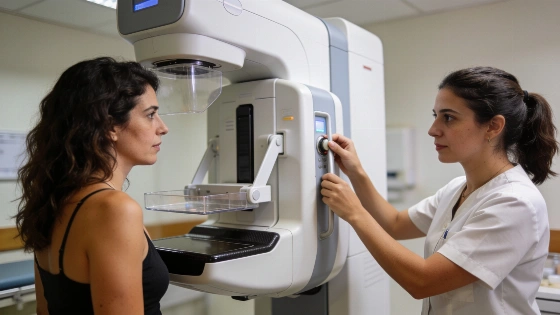
Called Transpara Risk Index, the system analyses digital mammograms and tomosynthesis scans. It estimates the statistical probability of a cancer diagnosis over the next five years by measuring breast density and patterns in tissue texture that may be difficult to spot by eye.
The model was trained on more than 200,000 mammograms and about 6,000 cancer cases. Its training data included more than 13 years of follow-up.
In the current study, the tool’s AUC was 0.71 at two years. It was 0.70 at three years and 0.69 at five years. AUC measures how well a system distinguishes between women who later develop cancer and those who do not. The highest-risk 10% accounted for about 30% of cancers diagnosed within five years. By comparison, the 10% with the greatest breast density accounted for 13%.
The findings remain preliminary. Six centres in the United States and Europe are testing the system independently at scale, using equipment from three manufacturers. The results do not establish a new screening schedule.
According to Marina Álvarez, the tool was trained on more than 200,000 mammograms and 6,000 cancer cases, with follow-up exceeding 13 years. An earlier external validation involving more than 65,000 studies from European and US centres found AUC values between 0.73 and 0.75. In that analysis, the 10% ranked at highest risk accounted for 39.3% of cancers diagnosed later.
Álvarez is a breast radiologist with the Sociedad Española de Radiología Médica (SERAM). She heads Radiodiagnóstico at Hospital Universitario Reina Sofía de Córdoba and researches at Instituto Maimónides de Investigación Biomédica de Córdoba (IMIBIC). Both Córdoba centres are the only Spanish participants in the current study.
A routine scan could make personalised screening easier to put into practice. Earlier approaches based on breast density faced barriers including cost. Time and limits to precision also proved difficult. Clinical tests and genetic studies have faced similar barriers.
A separate European effort is testing AI in healthcare through a cardiovascular AI project covering six applications across 13 countries.
A Swedish study examined 20,187 mammograms from 7,430 women screened between 2008 and 2016. It recorded 741 cancers within two years, including 217 interval cancers. These were diagnosed after a negative screening result but before the next scheduled round. In that dataset, Transpara Risk had an AUC of 0.81 for short-term prediction. At 90% specificity, it identified 49.8% of interval cancers.
Depending on the estimated risk, doctors could consider changing mammogram intervals. They could add more sensitive imaging, such as MRI. Contrast mammography could also be considered, along with additional preventive measures for women at higher risk.