The design of traditional wooden clothespins is more deliberate than it appears. Two distinct cavities between the jaws allow for a secure grip on clotheslines and fabrics of varying thickness, while the real clamping force comes from the metal spring. Here’s how these details make a difference in everyday laundry.
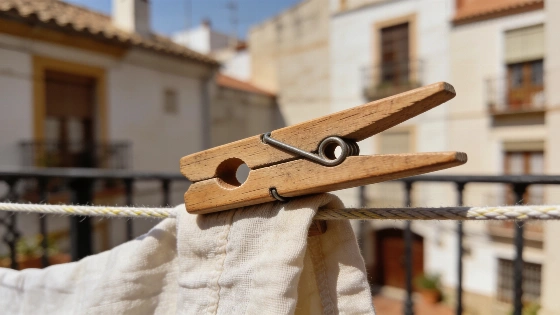
Pick up a classic wooden clothespin and you’ll notice two visible cavities carved between its jaws—one larger, one smaller. These aren’t decorative, nor are they meant for threading extra lines. Their purpose is practical: to accommodate both the clothesline and fabrics of different thicknesses, ensuring a reliable hold during drying.
The larger opening is designed to fit over the clothesline and the bulkier parts of garments, such as seams or hems. Its rounded shape leaves enough space for thicker lines or heavier fabrics, preventing the pin from slipping or distorting the material. This detail dates back to the 19th century, with David M. Smith’s 1853 patent already describing a cavity between the mouth and hinge specifically for this function.
How Each Cavity Works
Despite being called “holes,” these are actually recesses formed by matching grooves in the wooden halves. The larger cavity holds the line and the trapped fabric, while the smaller channel is intended for thinner textiles. If the opening is too wide, a clothespin can slide along the line, especially with lightweight fabrics. Some manufacturers have narrowed this second channel to improve grip on delicate items, keeping the line closer to the gripping surfaces. The exact geometry varies by brand and model, so not all pins behave identically.
The Role of the Spring
It’s a common misconception that the large hole provides the clamping force. In reality, the pressure comes from the metal spring, which keeps the two halves pressed together. When you squeeze the handles, the jaws open around a central pivot; releasing them lets the spring snap the jaws shut, holding the fabric in place. Solon E. Moore’s 1887 patent described this spiral spring as a mobile fulcrum, a principle still found in most modern wooden and plastic clothespins.
The interior profile of the pin helps it adapt to different fabric thicknesses without opening wider than necessary. The strength of the spring, the contact surface, the type of fabric, and the drying time all influence whether a pin leaves marks. A very stiff pin can imprint even well-designed cavities onto clothes.
Reducing Marks and Slippage
To avoid visible marks, shirts and T-shirts are best clipped by a seam, hem, or less visible area, rather than the center of the fabric. For thin materials, the narrower channel can provide a firmer hold if the pin’s design allows. Heavier garments may require two pins to distribute the weight and prevent stretching. Placing pins symmetrically helps clothes keep their shape as they dry.
For best results, the pin should close fully with the line inside the rounded cavity. If the wood is warped or the spring has lost tension, the grip will be uneven. Overloading the jaws with too much fabric can also cause deeper creases and slower drying. On thick rods, a larger pin may be needed to ensure a proper seal.
Drying Efficiency and Airflow
How you hang your laundry affects drying time as much as the pins themselves. Clothes should be shaken out and spaced apart on the line to allow air to circulate. Arranging longer items at the ends and shorter ones in the center creates an arch that improves airflow. Indoors, place the drying rack in a well-ventilated room, away from walls and curtains.
Giving laundry an extra spin cycle can help, provided it’s safe for the fabric. The evolution of the clothespin’s design—separating the gripping and guiding functions—reflects decades of small but meaningful improvements. As noted in Solon E. Moore’s 1887 patent, the slots guide the line while the spring provides the force.
Ultimately, the holes in a clothespin are there to fit the line and fabric, but it’s the spring that does the real work. Drying results depend on the pin’s design, the space available, and how the laundry is arranged.