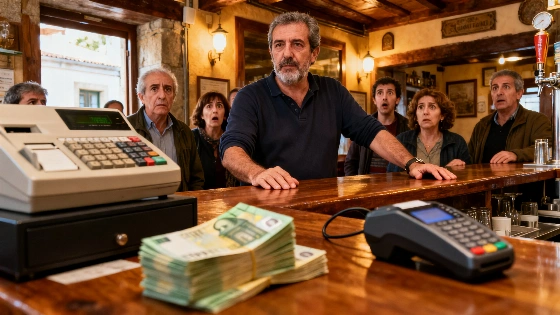
Bar Owner in Galicia Refuses Card Payments to Safeguard Profits. The owner of O Galeón bar in Catoira has stopped accepting card payments altogether to avoid paying bank commissions. His decision highlights growing discontent among small business owners over the costs of electronic transactions.
In recent years, Spain has been rapidly moving towards a cashless society: cards, mobile apps, and electronic payments have become the norm, even for the smallest purchases. However, not all entrepreneurs are ready to follow this trend. The owner of the bar O Galeón in Catoira (Pontevedra) has made a principled decision—to completely refuse card payments and any electronic payment methods. The reason is simple: to preserve profits and not give a portion of earnings to banks in the form of commissions.
Today, many customers no longer carry cash, preferring to pay by card or phone. But for small businesses, especially in the food service and retail sectors, each card transaction means extra costs. As the owner of O Galeón notes, even the smallest commission on every transaction significantly impacts overall profits in the end. According to him, he is not willing to share his income with banks, even if the amounts are small.
Commissions and Their Impact
For small establishments, acquiring commissions become a noticeable expense. In addition to a percentage from each transaction, entrepreneurs often have to pay for terminal rental or monthly service fees. When profit margins are already low, such costs can become critical. As a result, some small business owners look for ways to cut losses: some set a minimum amount for card payments, while others, like O Galeón, refuse electronic payments altogether.
At the entrance to O Galeón bar, a sign asks customers to pay only in cash. This is not a matter of convenience, but an attempt to keep the business afloat. The question faced by every small business owner: can you afford to lose part of your revenue to commissions for the sake of customer convenience?
How much does card acceptance cost
The commission rate depends on the terms of the agreement with the bank or terminal provider. For large companies, the fee is usually 0.3–0.5% of the transaction amount; for small businesses and sole proprietors, it can reach up to 0.9%. Some payment platforms charge over 1.5%, and certain models include fixed monthly fees or device charges. The final amount a business loses to commissions can vary significantly depending on turnover and contract terms.
These costs are known as the discount rate, and for small businesses they are especially significant. When every percent counts, entrepreneurs are forced to choose between customer convenience and financial stability.
Legal restrictions
European legislation limits the size of interbank commissions: for debit cards, no more than 0.2%; for credit cards, up to 0.3%. However, under Spanish law, businesses are not allowed to pass these expenses on to the client as additional fees. If an establishment accepts cards, it must include all costs in its service prices, without itemizing them separately.
The situation where small businesses are forced to choose between customer convenience and their own profitability is becoming increasingly relevant. As reported by Talent24h, the decision of O Galeón's owner is just one example of how entrepreneurs are responding to rising costs associated with digital payments.
The issue of fairness of bank commissions and their impact on small business has repeatedly been a topic of discussion in Spain. For example, court rulings on banking terms, such as in the case of foreign currency mortgages, also highlight the importance of protecting the interests of consumers and entrepreneurs. More details on such disputes can be found in the article on the invalidation of foreign currency terms in Barclays mortgages: the decision of the Supreme Court of Spain on multi-currency loans.