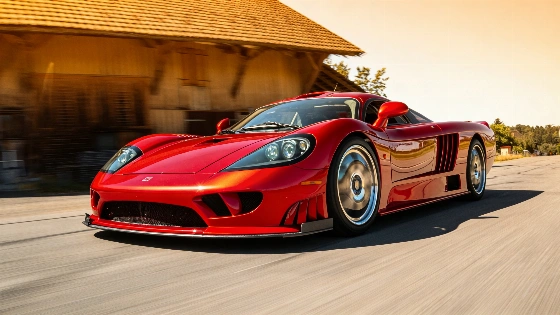
Saleen S7 Twin Turbo: the American supercar that outpaced Ferrari and Lamborghini. The Saleen S7 Twin Turbo is a rare American supercar that challenged Ferrari and Lamborghini in the early 2000s. We explore how it made its way to Europe, what still makes it impressive 25 years on, and why it has been largely forgotten.
In the Swiss city of St. Gallen, there is a car that was once considered the embodiment of the American dream on wheels. The Saleen S7 Twin Turbo is the only one of its kind in Europe, and its appearance on the streets causes as much astonishment as encountering a rare piece of art. In the early 2000s, this supercar was featured in 50 Cent’s music videos and movies with Jim Carrey, and today it is remembered only by collectors and aficionados.
The model’s creator, Steve Saleen, was well known in American motorsport since the 1970s, but it was only in 2000 that he presented his first fully original car. The Saleen S7 immediately declared itself as a contender on the world stage: mid-engine layout, carbon fiber body, minimal weight, and no electronic aids. At a time when the Ferrari Enzo and Porsche Carrera GT were only preparing for their debut, the S7 was already offering 558 hp and 0 to 100 km/h in 3.3 seconds.
Technology and Power
In 2005, Saleen went further and released the Twin Turbo version. Two Garrett turbochargers boosted the power to 760 hp and the torque to 949 Nm. At the same time, the car’s weight remained at 1,350 kg, which gave it outstanding performance: the officially stated top speed was 399 km/h, and acceleration to 100 km/h took less than 3 seconds. Even by the standards of today’s hypercars, these numbers are impressive.
Inside, the S7 reflects its origins: simple trim, minimal adjustments, everything tailored for a specific owner. The seat, steering wheel, and pedals are not adjustable — each car was built individually. However, this does not detract from the car's ability to deliver a unique driving experience. The sound of the V8 without mufflers, long gear ratios, and the lack of electronic aids turn every drive into a test of attentiveness and reflexes.
Driving impressions
On the road, the S7 Twin Turbo behaves surprisingly predictably for its size: almost five meters long and two meters wide. Thanks to a combination of a steel and aluminum monocoque with a carbon fiber body, the car remains light and responsive. But pressing the accelerator changes its character: after 4,000 rpm, the engine literally explodes with power, and acceleration becomes almost aggressive. On original twenty-year-old tires, even experienced drivers do not dare to test its limits.
The owner of this unique specimen, Fredy Linhard, has managed to preserve the car in almost factory condition: the odometer shows only 1,360 kilometers. Over two decades, the S7 has barely left the garage, and today it can be considered not only a rarity, but also part of American automotive history. As russpain.com notes, interest in unique supercars has not faded — it's enough to recall the story of the only Ferrari HC25 with a V8 for 3 million euros.
Why it was forgotten
Despite its motorsport achievements—the S7R version won over 100 races—the Saleen S7 never became a mainstream icon. The reason was the lack of a recognizable brand and a limited production run. European collectors preferred Ferrari, Lamborghini, or Porsche, leaving the American supercar in the shadows. Even today, its value on the secondary market does not reach the prices of legendary models from Italy or Germany.
Nevertheless, the S7 Twin Turbo remains one of the brightest examples of how a small company can create a car ahead of its time. Its design still looks relevant, and the driving experience is incomparable to modern cars, where electronics handle almost everything. For those seeking a true analog driver's car, the Saleen S7 is a rare chance to touch an era when power and character mattered more than the brand.