A major wildfire near Niebla, Huelva, has already affected 4,000 hectares. Shifting winds and difficult terrain have forced 66 people to evacuate. Emergency services, including the UME, are working to contain the blaze.
Emergency services in Huelva province are battling a severe wildfire that broke out Friday afternoon near Niebla, with the affected area now estimated at around 4,000 hectares. The situation escalated overnight as unpredictable winds repeatedly shifted direction, undermining firefighting strategies and forcing authorities to raise the emergency to operational level 2. The fire remains uncontrolled, and the outlook for the coming hours is uncertain due to continued meteorological instability.
Firefighters on the ground faced gusts of up to 50 km/h, which opened new fronts and made containment impossible during the night. By Saturday morning, the wind had shifted again, now pushing the flames toward the southeast. The rapid changes have left only limited opportunities to halt the fire’s advance, according to Antonio Sanz, Vice President of the Junta de Andalucía and head of Emergency Services. The northern sector of the blaze has expanded aggressively, further complicating efforts.
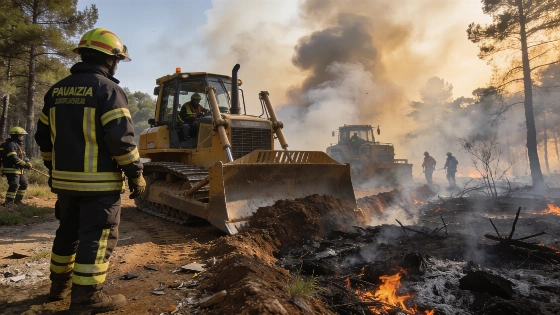
To reinforce local teams, the Unidad Militar de Emergencias (UME) deployed 60 personnel and 15 vehicles overnight, working alongside Infoca units. Heavy machinery and drones have been used to assess and tackle the most affected zones. At dawn, 24 aircraft, 215 ground personnel, 94 vehicles, a medical unit, a meteorological team, and seven bulldozers were mobilized to try to establish a perimeter around the fire. Despite these efforts, the fire’s unpredictable behavior continues to challenge all involved.
Evacuations have been carried out as a precaution in several communities. On Friday, about 40 residents from La Florida, as well as people from Las Arenas and El Manzanito, were asked to leave their homes. Most evacuees have found shelter with relatives or returned to their primary residences, while only a handful required temporary accommodation. These latest evacuations add to those ordered earlier in Raboconejo and Caballón. In total, 66 people have been displaced due to the fire.
Two key roads, the HU-3106 between Niebla and Valverde del Camino and the A-493, remain closed to traffic. The ground operation has been reinforced, and bulldozers have expanded firebreaks near the Villarrasa waste plant. Local officials, including Huelva’s regional delegate Berta Centeno and Niebla’s mayor Joaquín Molina, have highlighted the ongoing risk posed by shifting winds and the difficulty of predicting the fire’s path. The cause of the blaze is under investigation, with no hypothesis ruled out at this stage.
The mayor of Niebla expressed gratitude for the efforts of both aerial and ground teams, as well as local hunters who have assisted in an area known for its hunting value. Meanwhile, the Valverde del Camino town council has warned residents that smoke from the fire may affect air quality throughout the day, advising people to keep windows closed and take precautions, especially for children, the elderly, and those with respiratory conditions. Residents are urged to follow all instructions from emergency services.
Support and solidarity have been expressed by local authorities for those affected, and recognition has been given to the Infoca firefighters and all emergency personnel working tirelessly to control the situation. The challenges faced in Niebla echo the difficulties seen in other Spanish disasters, such as the Biescas camping flood, which also tested emergency response and community resilience, as detailed in this retrospective on the Biescas tragedy.
Wildfires are a recurring threat in Spain’s southern regions, particularly during periods of high temperatures and dry conditions. The combination of dense vegetation, rural settlements, and unpredictable weather patterns often complicates firefighting efforts. Authorities continue to monitor the situation closely, with additional resources on standby should conditions worsen.