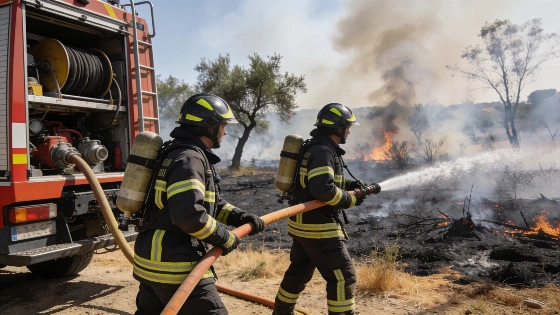
The wildfire near Niebla, in the province of Huelva, was initially reported to have scorched 4,000 hectares and prompted the evacuation of about 70 residents as emergency services worked to contain the advancing flames. The blaze began on 6 August 2026 in the Raboconejo area and later spread across parts of Huelva and Seville provinces. Shifting winds and the fire’s unpredictable behavior led authorities to deploy additional resources and raise the emergency level.
By early morning, the Plan Infoca operation had mobilized 24 aircraft, including helicopters and planes, alongside 275 ground personnel and 94 vehicles. The deployment included seven bulldozers, a medical unit, a meteorological team and a command module, all supporting frontline crews and the construction of containment lines. The Unidad Militar de Emergencias (UME) joined with 60 military personnel and 15 vehicles, including teams using heavy machinery and drones to assess affected areas.
The decision to involve the UME followed Antonio Sanz, Andalusia’s regional minister for the Presidency, Health and Emergencies, raising the emergency to operational level 2. The classification placed the Niebla fire among three Andalusian incidents reported to reach that level during the 2026 season; level 2 entails UME intervention. A regional season summary recorded 19 fires at level 1 and three at level 2, with 6,444 people evacuated across Andalusia because their lives were at risk.
Additional support arrived from neighboring regions. Extremadura’s Plan Infoex dispatched a heavy-machinery team, including bulldozers and support vehicles, as well as a natural-environment agent who traveled overnight from Zafra, in Badajoz province. Firefighters from the Huelva Provincial Consortium and Extremadura also joined the containment effort, bolstering a response that grew into a prolonged, multi-agency operation.
Evacuations expanded the previous day, with around 40 people from 20 homes in La Florida, along with residents of Las Arenas and El Manzanito, leaving as a precaution. Most evacuees stayed with relatives or returned to their core residences, while five people were accommodated in a designated hostel. Earlier evacuations in Raboconejo and Caballón involved second homes, so no additional shelter was required. As the fire spread across municipalities in Huelva and Seville, the total number of evacuees ultimately rose to 417 from 11 municipalities.
Later assessments put the fire’s footprint far above the initial 4,000-hectare estimate. Reports put the area affected at roughly 33,000 to 39,821 hectares, with one estimate recording about 38,000 hectares after nine days. The figures vary by assessment and by whether they describe the affected perimeter or land burned; the fire was ultimately compared with the 2004 Riotinto blaze, which burned about 34,000 hectares. Canal Sur’s Los Reporteros described the Niebla fire as “the most dangerous in the history of the autonomous community” and reported that it was extinguished after 15 days of continuous firefighting.
After ten days, authorities said the fire had stabilized, with no further advance and a favorable outlook. Juan Manuel Moreno, president of the Andalusian regional government, said the blaze was “stabilized”; conditions improved enough for the 417 evacuees to return home, while the UME began withdrawing and officials expected the emergency status to move from level 2 to level 1. Across Andalusia, the 2026 fire season burned an estimated 58,735 to 59,685 hectares of woodland, scrubland and pasture, more than seven times the region’s average annual forest-fire area, information from regional reporting.
The consequences extended beyond firefighting and evacuation. On 23 October, Andalusian parliamentarian Rafael Sánchez Rufo of Por Andalucía registered an initiative asking the regional government to suspend hunting drives in affected hunting grounds. He called the fire an “authentic environmental catastrophe,” drawing attention to the August blaze’s effects on land management and wildlife.
The incident highlights the continuing wildfire risk to rural communities and natural landscapes in Spain, particularly during periods of high temperatures and variable winds. The Niebla fire’s rapid escalation and scale echo concerns raised in other regions, including when several Madrid municipalities cancelled public events due to fire danger, as reported in recent coverage of wildfire precautions in Madrid. The response relied on interregional cooperation and military support, while expanding evacuations put resident safety alongside fire containment.