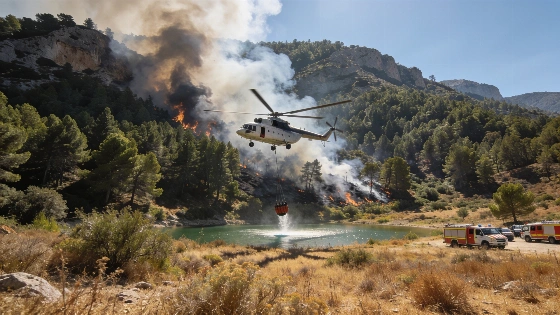
A major forest fire in Soneja has triggered the evacuation of more than 500 people from Azuébar. Emergency services have deployed extensive ground and aerial resources. Authorities warn of worsening conditions.
Emergency services in Castellón are battling a fast-moving wildfire that broke out in the Soneja area, prompting the evacuation of more than 500 residents from the nearby town of Azuébar. The fire, which started in a forested zone of Soneja, has rapidly intensified due to adverse weather, with high temperatures above 30°C, wind gusts exceeding 30 km/h, and low humidity creating the worst possible conditions for containment.
Authorities have declared Situation 2 of the Special Plan for Forest Fire Risk in the Comunitat Valenciana, a status reserved for incidents that pose a serious threat to people, property, or infrastructure. This escalation has led to the deployment of a large-scale response: four units from the Castellón Provincial Fire Consortium, eight teams of Forest Firefighters from the Generalitat Valenciana—three of them airlifted—alongside ten aerial resources, two forest coordinators, a technical specialist, and the Mobile Command and Communications Unit, which has set up an Advanced Command Post.
To support the aerial operations, the port of Sagunto has been closed to facilitate water loading for helicopters and planes. A 35,000-litre tanker truck has also been dispatched to reinforce water supply for ground crews. The Unidad Militar de Emergencias (UME) has joined the firefighting effort, as confirmed by the Government Delegate in the Comunitat Valenciana, Pilar Bernabé.
Local officials have voiced concern about the fire's progression. Soneja's mayor, Benjamín Escriche, reported that the evacuation of Azuébar is underway, with residents being relocated to Soneja as a precaution. The main worry centers on the urban area of Azuébar, as shifting winds have pushed the flames closer to the town, despite the fire's origin being some distance from populated zones. Jessica Miravete, mayor of Azuébar, stated that around 500 people have been moved and that the timeline for their return remains uncertain as aerial firefighting continues.
The firefighting operation remains ongoing, with authorities urging extreme caution in the affected areas and maintaining constant monitoring of the situation. The negative evolution of the fire has led to a significant increase in both ground and aerial resources, reflecting the seriousness of the threat. The closure of the port and the scale of the response underline the logistical challenges faced by emergency teams.
This incident follows a series of vegetation fires in the region, including recent outbreaks in Cullera, la Pobla de Vallbona, and Rafelguaraf. The current situation in Soneja echoes other major wildfires in Spain, such as the one that led to lockdowns in several Catalan towns last year—details of which can be found in this report on emergency measures during the La Bisbal d'Empordà fire.
Forest fires are a recurring challenge in Spain, particularly during periods of extreme heat and drought. The Comunitat Valenciana, with its extensive woodland and rural communities, is especially vulnerable. Authorities regularly update emergency protocols and invest in both prevention and rapid response capabilities. The involvement of the UME and the activation of advanced command structures reflect the evolving approach to managing large-scale incidents. Residents in affected areas are advised to follow official instructions and remain alert to further developments as firefighting efforts continue.