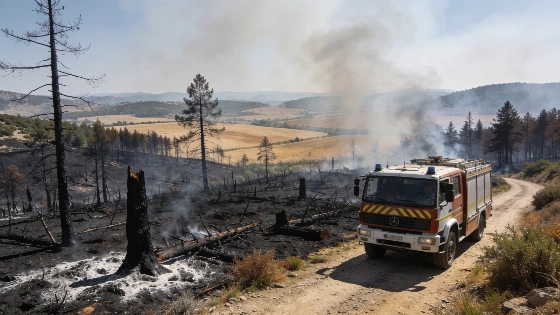
Emergency services in Aragón remain on high alert after a wildfire in Tamarite de Litera, Huesca, scorched more than 4,000 hectares, mostly agricultural land and scrub, with some pine forest also affected. The fire broke out on Thursday in June 2026, prompting a major deployment of firefighting resources and evacuations in several rural communities. By early afternoon, officials said the perimeter was under control and the fire had stopped advancing. Crews continued securing the fireline and preventing flare-ups. The perimeter was controlled, but the fire was not fully extinguished: high temperatures, low humidity and winds similar to those during the initial spread kept the risk of renewed activity high.
Teams from the Government of Aragón, national agencies, the Military Emergencies Unit (UME), the Government of Catalonia and the Valencian Community took part, with reinforcements from Castilla y León expected. José Carlos Campo, the Government Subdelegate in Huesca, said the available resources were sufficient and praised coordination among the participating administrations. The Guardia Civil remained deployed to protect evacuated residents and support access restrictions.
Aragón’s Minister for the Environment and Tourism, Luis Biendicho, said crews were concentrating on the fire’s right flank, particularly its northern and southern sectors. The left flank showed little fire activity, as aerial and ground crews worked to keep the flames from reaching forested areas. Fonz was released from confinement after smoke levels fell, but 240 residents of Azanuy, Alins and Calasanz were still unable to return home. They were allowed brief, supervised visits to collect impressive belongings and care for animals.
Conditions remained challenging, with high temperatures and low humidity, while winds were similar to those that fueled the initial spread. The priority was to hold the perimeter and prevent flare-ups, especially near forested areas, with aerial and ground crews on the job. No injuries were reported, and property damage was described as relatively limited. Authorities credited the rapid, coordinated response.
In response to the ongoing risk, the Government of Aragón activated Red Alert Plus for extreme wildfire danger across the region for the entire weekend. The measures banned open fires, suspended agricultural and forest burning, restricted machinery that could spark new fires, limited vehicle access to forest areas and prohibited public or sporting events in high-risk zones. Impressive agricultural activities and urgent repairs to basic services were allowed only under strict safety protocols and with prior notification to emergency services.
As of 14:00, the firefighting operation included seven helicopters, a coordination helicopter, seven helitransported crews, eight fire engines, eight ground teams, four bulldozers, technical staff, light vehicles, GADEX personnel and a technical director. Additional support came from Civil Protection, 061, IASS, Huesca Provincial Firefighters, the Ministry for Ecological Transition and the Demographic Challenge (MITECO), the Ministry of Defence, the Valencian Community, Catalan Firefighters, the Guardia Civil and the Red Cross. The Red Cross prepared 75 beds and emergency support at the Monzón sports hall.
State resources included 148 personnel from three UME sections, six fire engines, a bulldozer, a thermal drone and MITECO aerial assets, including amphibious planes and coordination aircraft. The fire’s elongated perimeter covered an area made up mainly of farmland and scrub. Crews continued reinforcing containment and preventing new outbreaks as the region faced another day of heat and low humidity.
Aragón’s response extended beyond firefighting to post-fire restoration. Work reported in October 2026 in areas affected by the Tamarite fire and other Aragón wildfires included cutting fire-damaged trees and using branches and other vegetation residues to build “fajinas,” barriers designed to slow runoff and help retain soil.
The recovery effort also included a regional compensation structure for damage from the 2026 summer fires. The Government of Aragón’s Order ECE/1370/2026, dated 23 September, established urgent rules and opened subsidies for repairs and compensation. The measure was registered by the National Commission on Markets and Competition as case SA.125095. The scheme covered the broader Aragón fire season, not Tamarite alone. The regional government later reported 44 applications from small businesses and self-employed workers affected by the fires, while a related report said 91% of the available budget for those applicants remained unused.
Wildfires are a recurring threat in Spain’s rural regions, especially during extreme weather. In this incident, high temperatures, low humidity and wind meant that stopping the fire’s advance was only one stage of the response. Crews also had to secure the perimeter and guard against flare-ups, while emergency restrictions remained in place to reduce the risk of new fires.