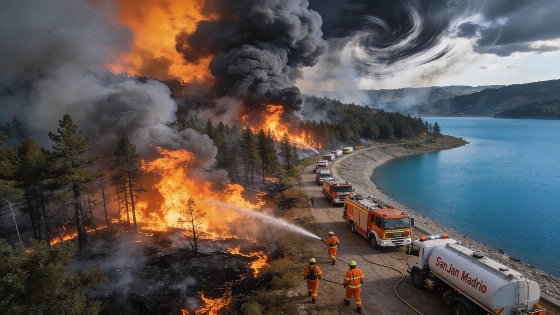
Firefighters in Madrid face strong winds as wildfires threaten homes and force evacuations. The blaze has already consumed 25,000 hectares. Authorities focus on the San Juan reservoir area, where fires from Ávila and Madrid converge.
Emergency teams in Madrid are struggling to contain a major wildfire that has already scorched 25,000 hectares in the Sierra Oeste region. Overnight, firefighters worked to stabilize the blaze, but wind gusts reaching 30 kilometers per hour continue to complicate efforts, especially around the San Juan reservoir near San Martín de Valdeiglesias. This area has become a critical front, as flames from Madrid have intermittently merged with those from the Burgohondo fire in Ávila, which has devastated approximately 50,000 hectares.
Authorities report that the situation remains volatile. The most concerning zones include the vicinity of the Cofio river, the El Encinar del Alberche urbanization in Villa del Prado—which faced a second evacuation on Sunday—and residential areas south of the San Juan reservoir. Firefighting resources are concentrated here, where the risk of further spread is heightened by unpredictable wind patterns and the convergence of multiple fires.
Despite the challenges, the night brought some progress in Burgohondo, Ávila, where crews managed to control a dangerous incident after embers crossed a protected roadway in Sotillo. However, new threats emerged late Sunday, with a fresh blaze reported from Almorox in Toledo, adding to the complexity of the emergency response across three regions. In total, around 90,000 people have been evacuated or confined due to the ongoing fires.
This morning, Prime Minister Pedro Sánchez is scheduled to visit the area affected by the Vall d’Uixó fire in Castellón. That blaze has already impacted more than 4,300 hectares and forced the evacuation of over 16,000 residents from nearly twenty municipalities. Sánchez will meet with emergency teams at the Advanced Command Post in La Vall d’Uixó to assess the situation and coordinate further action.
The scale of the Burgohondo fire in Ávila now marks it as the largest wildfire in Spain’s recorded history, according to Sara Aagesen, Minister for the Ecological Transition and Demographic Challenge (Miteco). The ongoing crisis has prompted a massive mobilization of firefighting resources and highlighted the vulnerability of rural and peri-urban communities to extreme fire events.
For additional context on the evolving wildfire situation in Madrid and the challenges posed by merging fire fronts, see the detailed coverage in this recent report on emergency operations in southwest Madrid.
Spain’s wildfire season has grown increasingly severe in recent years, with climate conditions such as prolonged drought, high temperatures, and strong winds contributing to the frequency and intensity of major fires. The current emergencies in Madrid, Ávila, and Castellón underscore the need for coordinated regional responses and ongoing investment in fire prevention and rapid intervention capabilities. As authorities continue to monitor weather forecasts and deploy resources, residents in affected areas are urged to follow official instructions and remain alert to changing conditions.