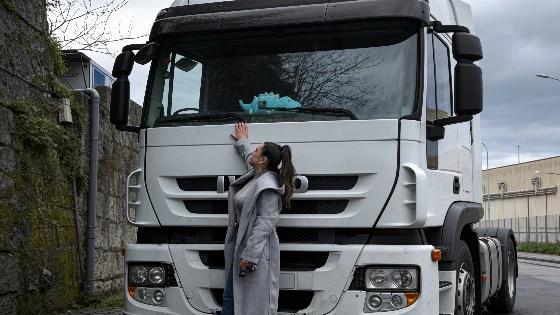
At 25, Andrea Fernández is one of the few women behind the wheel of a heavy truck in Spain. Her journey from logistics worker to admired driver reveals how new generations are quietly changing the face of the industry.
When Andrea Fernández steps out of her container truck at a Galician port, heads turn. At just 25, she is part of a tiny minority—women make up only about 2% of Spain’s professional truck drivers. Yet, as Fernández navigates the region’s highways and docks, she finds herself not isolated but welcomed. “I feel admired. People are surprised. They help me with everything,” she says, summing up the reactions she encounters daily.
Fernández’s path into heavy transport was anything but traditional. With no family background in trucking—apart from a distant relative she learned about only later—her interest grew gradually while working at a fruit warehouse. Watching drivers arrive in their massive vehicles sparked her ambition to earn a truck license. She briefly considered driving a bus, but the responsibility for passengers’ lives felt overwhelming. Instead, she chose the independence of freight transport, despite initial doubts and concern from her parents and friends, who saw her decision as risky and unconventional for a young woman.
I feel admired. People are surprised. They help me with everything.
Those warnings only strengthened her resolve. Fernández admits that the lack of early support became a motivator, pushing her to prove herself in a field where women are still rare. Today, she covers regional routes across Galicia, connecting major ports like Vigo, Marín, and Vilagarcía de Arousa with distribution centers and clients. Her cargo ranges from food to textiles, and her constant companion is Brugal, a chocolate labrador who has become a familiar sight in her cab and a source of comfort during long waits and challenging days.
Despite the sector’s reputation for toughness, Fernández describes a work environment marked by solidarity. The initial surprise at seeing a young woman behind the wheel quickly gives way to camaraderie and practical support, especially during demanding tasks like handling heavy containers or coupling trailers. She notes that the daily realities of the job—long waits at port terminals, unpredictable weather, and the challenges of Galicia’s secondary roads—require adaptability and resilience. Yet, she values the flexibility and ongoing learning the profession offers, preferring it to the routine of office work.
For Fernández, driving a truck is more than a job; it is a form of personal achievement and a way to challenge social stereotypes. Her experience highlights how technical skill and composure at the wheel are not defined by gender. As she continues to build her career, her story offers a fresh perspective on Spain’s transport industry and may encourage more women to consider the road as a viable career path.
Spain’s automotive and transport sectors have long been shaped by tradition, but stories like Fernández’s signal a gradual shift. The arrival of iconic vehicles such as the Opel Corsa, which transformed Spanish roads and mobility in the 1980s, marked earlier milestones in the country’s transport evolution. Today, the presence of women like Fernández behind the wheel points to a new chapter—one where diversity and determination are quietly redefining the industry. The impact of vehicles like the Opel Corsa on Spain’s roads shows how change often begins with individuals willing to take the first step.