Zheng Qinwen came back from 5-0 down and match point to beat Madison Keys at the US Open. The Chinese qualifier moves into the fourth round after a year of surgery and setbacks. Her dramatic win marks a turning point in her return.
Zheng Qinwen was down 5-0 and facing match point in the final set against Madison Keys. It looked over. Instead, the Olympic champion put together seven straight games to win 1-6, 7-6 (7-3), 7-5 and reach the fourth round as a qualifier. Keys, seeded 22nd and a former Australian Open winner, had controlled the match early and seemed headed for a routine win before Zheng turned it around.
This comeback was about more than the score. Zheng has spent the past year dealing with injury and uncertainty. She had elbow surgery in July 2025 to remove bone fragments, then missed nearly half the season with pain and a slow recovery. According to the Australian Open, she missed the rest of 2025 and the 2026 Australian Open. Her ranking fell outside the top 100, dropping as low as 121, and she lost direct entry into Grand Slam main draws. In New York, she had to play qualifying rounds for the first time in four years.
Zheng had to win five consecutive matches at the US Open, including qualifying, before facing Keys in the third round—her longest winning streak since returning from injury.
Australian Open
The road back has been rough. Zheng said she felt lost after her early exit at Roland Garros, her first major since surgery. “After coming back from injury I felt I lost the energy and I forgot how to compete,” she said. She broke down in tears after qualifying for the main draw, calling it a harsh reset for someone who had recently been ranked as high as world number four. After beating Yulia Putintseva, Zheng said she finally "found herself" again at this tournament, describing her run in New York as part of a longer recovery, not just a single good week, as reported by Xinhua and Yahoo.
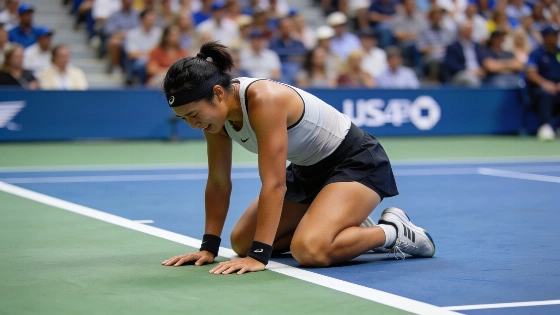
Against Keys, Zheng had to keep her focus under pressure. At 5-4 in the final set, a crying baby in the stands interrupted her serve. Zheng paused, regrouped, and won four straight points to tie the match. She managed to block out the noise and nerves, then finished the comeback and collapsed on the court in disbelief. According to Xinhua, her win over Putintseva was already her first time in the third round of a major since Roland Garros 2025, showing how far she had come in New York.
Her run has been defined by resilience. Four of her six matches have gone the distance, and she is the first qualifier to reach the women’s fourth round at the US Open since Emma Raducanu in 2021. Zheng’s path has been different from other top players, such as Carlos Alcaraz, whose progress at the tournament was reported earlier.
Before facing Keys, Zheng had already defeated Xiaodi You, Clara Burel, Elena Pridankina in qualifying, and Kristina Liutova and Yulia Putintseva in the main draw, showing steady improvement throughout the tournament. Her breakthrough in New York, as she told Yahoo, was regaining her competitive fire after months of feeling disconnected from the sport.
Yahoo/Xinhua
Zheng did not qualify for a protected ranking because she played her home event in Beijing last October, which cut short her recovery. That decision forced her into qualifying, a process she struggled with but eventually overcame. After the win, she said, “Finally, a bit of luck is on my side,” a mix of relief and exhaustion after a long year.
Zheng’s win over Madison Keys is more than a single upset. It shows how thin the margins are at the top of tennis, and how much mental strength matters. Coming back from match point and a year of setbacks, she refused to let injuries or rankings define her. In a sport where comebacks like this are rare, Zheng’s performance in New York stands out for its persistence and nerve.