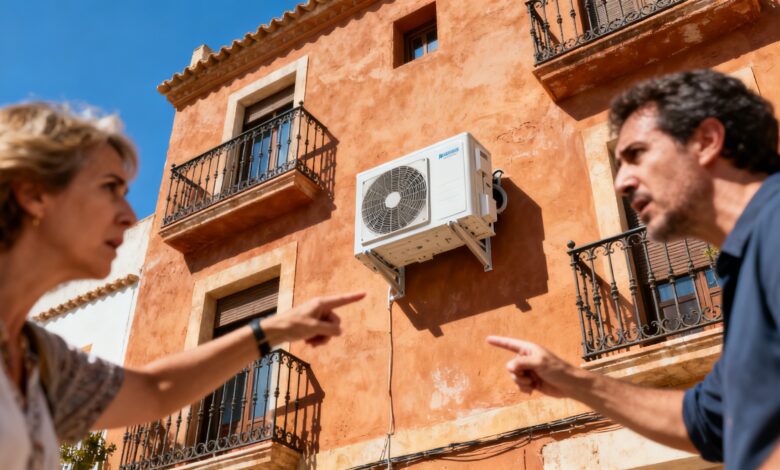
In Spain, with the arrival of summer, the question of installing air conditioners becomes especially relevant. However, the simple solution of mounting the external unit on the facade of an apartment building is not always permitted. The Horizontal Property Law, as noted by Talent24h, sets strict rules for such changes, and violating them can lead to serious consequences for the apartment owner.
Legal restrictions
The main provisions are contained in Article 7 of the Horizontal Property Law. According to the law, the owner has the right to make changes to the interior elements of their apartment, but any work affecting architectural details, shared utilities, or the building’s exterior requires prior notification and the consent of the homeowners’ association. The facade is considered a common element, so any interventions, including the installation of an air conditioner, cannot be made at the sole discretion of the resident.
Even if the need for cooling is obvious, especially during periods of abnormal heat, the law makes no exceptions. Quick installation without agreement with neighbors may lead to conflict and legal disputes. Moreover, the equipment must be installed by a qualified specialist, not by the apartment owner.
The role of the homeowners’ association
The reason for such restrictions is to protect the architectural integrity of the building and the interests of all residents. The exterior appearance of the facade affects the overall look of the building, and any changes may disrupt harmony and cause discontent among neighbors. The decision to allow or prohibit the installation of an air conditioner on the facade is made at a general assembly of property owners. For this, a project must be submitted indicating the proposed location, technical specifications, and the visual impact of the equipment.
The community’s interest in preserving the building’s unified style takes priority over individual needs. Even if the majority of residents support the installation, the approval process is mandatory. Otherwise, the owner risks being required to dismantle the equipment and compensate for any possible damages.
Exceptions and Alternatives
The law allows for exceptions if the installation of the air conditioner does not affect common elements or alter the building’s exterior appearance. For example, placing equipment on a private terrace or in an individual internal courtyard is permitted if this does not violate architectural harmony or disturb other residents. However, even in such cases, it is recommended to notify the community in advance to avoid future complaints.
If installation on the facade is not possible, alternative options should be considered: mobile air conditioners, placing the unit in an inner courtyard, on the roof, or in areas specifically designated for this purpose. Many modern buildings are already equipped with technical zones for such devices, and homeowners’ associations develop internal regulations governing their placement.
Consequences of unauthorized installation
Failure to comply with established rules can lead to serious consequences. The homeowners’ association has the right to demand immediate removal of the equipment. If the owner refuses to comply, the matter may be taken to court, where decisions usually favor the association. In addition to removal, the violator may face financial penalties and be required to compensate for any damage caused to the building’s communal elements.
Recent court practice confirms the priority of protecting facades as a key element of a building’s exterior appearance. Therefore, attempts to bypass the approval process rarely end in favor of the owner.
Procedure for legal installation
Before beginning work, it is important to determine whether the installation of the air conditioner will affect the building’s common elements. If so, it is necessary to:
- Check the possibility of placing the equipment in a private area without altering the facade;
- Notify the homeowners’ association about the planned work;
- Prepare a project with technical details and visualization;
- Obtain official permission at the general meeting;
- Consider alternative placement options if consent is not obtained.
Following these steps helps avoid conflicts and legal issues, as well as preserve good neighborly relations. With stricter regulations and an increasing number of complaints about building exteriors, taking the legal route has become the only reasonable solution.