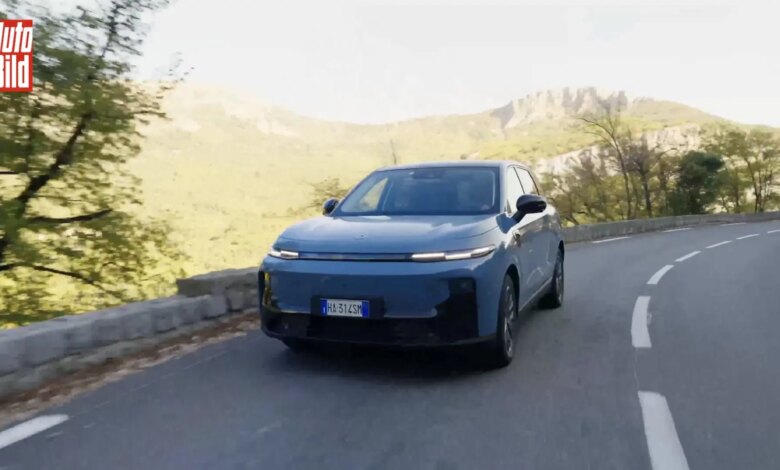
The arrival of the Leapmotor B10 on the European market has become a real challenge for the established players in the electric vehicle segment. The Chinese manufacturer, backed by Stellantis, has bet on combining an affordable price with impressive specs, immediately capturing the attention of buyers tired of the inflated prices of well-known electric car brands. In the first months after its launch in China, the model sold over 66,000 units—proof of high demand and growing trust in this new name.
In Spain and other European countries, the Leapmotor B10 is positioned as an alternative to the Volkswagen ID.4 and Skoda Enyaq but with a much more attractive price tag. This strategy not only challenges established European car giants but also forces them to rethink their approaches. As buyers increasingly prioritize practicality and savings, the Leapmotor B10 is becoming a symbol of change in the electric car market.
Features and equipment
This compact crossover, measuring 4.52 meters in length, 1.89 in width, and 1.66 in height, fits perfectly into the popular urban SUV segment. Slightly smaller than the Volkswagen Tiguan and ID.4, it offers easy maneuverability in city conditions without sacrificing spaciousness. The exterior stands out with its clean lines and modern LED lighting, while the interior immediately impresses with a rich array of standard features.
Standard equipment includes a panoramic roof and a 360-degree camera system—features often offered only as paid options by competitors. The trunk volume is 430 liters, which expands to an impressive 1,700 liters with the rear seats folded down. There’s an additional 25-liter front compartment for storing charging cables, which is especially convenient for electric vehicle owners.
The Leapmotor B10 interior is designed in a minimalist style but is not lacking in modern technology. Main functions are controlled via a touchscreen, though some settings still require the driver to look away from the road, which may not appeal to conservative drivers. Nevertheless, the ergonomics and material quality are pleasantly surprising, especially given the car’s price.
Performance and comfort
Leapmotor B10 does not aim to be sporty, focusing instead on comfort and ease of handling. The vehicle features three steering modes, three levels of regenerative braking, and three accelerator response options. This flexibility allows drivers to tailor the car’s behavior to their individual preferences, which is rarely seen in this price segment.
On the road, the crossover delivers impressive ride comfort, although sound insulation could be better—the cost-saving on materials is noticeable. Nevertheless, for city driving and suburban routes, the Leapmotor B10 is an ideal fit. Rear-wheel drive and 218 hp provide confident acceleration, while the smooth operation of the electric motor makes every journey as comfortable as possible.
Two battery options—56.2 and 67.1 kWh—allow drivers to find the optimal balance between price and range. Depending on configuration, the vehicle can cover 361 to 434 km on the WLTP cycle, placing it on par with more expensive competitors. Average energy consumption is about 17.2–17.3 kWh per 100 km, and in real-world conditions these figures are confirmed, especially with calm driving.
A breakthrough in pricing
The main advantage of the Leapmotor B10 is its price. In 2026, the starting price on the Spanish market is 27,851 euros, making it one of the most affordable electric crossovers in its class. For comparison, the Volkswagen ID.4 and Skoda Enyaq with similar specifications are significantly more expensive, especially when additional options are taken into account.
Such pricing forces European manufacturers to rethink their offerings and seek new ways to retain customers. The Leapmotor B10 doesn’t just offer an attractive price—it proves that a quality, high-tech electric car can be accessible to a wide audience. This is no longer just an alternative, but a true competitor capable of shifting the balance of power in the market.
The arrival of a new generation of Chinese electric vehicles in Europe is provoking mixed reactions. On one hand, consumers now have more choices and the opportunity to save, while on the other, traditional brands are losing their monopoly on innovation and are being forced to speed up their own development. The Leapmotor B10 has become a symbol of these changes, and its success could mark the beginning of a new era in the European automotive industry.
Leapmotor is a Chinese automotive brand founded in 2015, specializing in the production of electric vehicles for the mass market. The company quickly gained popularity in its domestic market thanks to its combination of advanced technology and affordable pricing. In 2024, Leapmotor entered into a strategic partnership with the international group Stellantis, enabling the brand to enter the European market and offer its models to a wide audience. Today, Leapmotor is actively expanding its electric vehicle lineup, focusing on innovation and practicality—a strategy that has already led to significant changes in the structure of demand in the European electric vehicle market.