Less than two hours from the bustling Spanish capital, hidden among the river valleys and silent meadows of the Alcarria region, lies a place sure to impress even the most seasoned traveler. This is not just a collection of ruins; it’s a monumental complex steeped in mystery and near-total obscurity. Unlike the better-known monasteries of Guadalajara province—such as Monsalud or Bonaval—this site offers a completely different experience: an immersion in history far from the crowds, surrounded by nature and age-old stones. It’s the perfect route for those seeking unique cultural discoveries near Madrid.
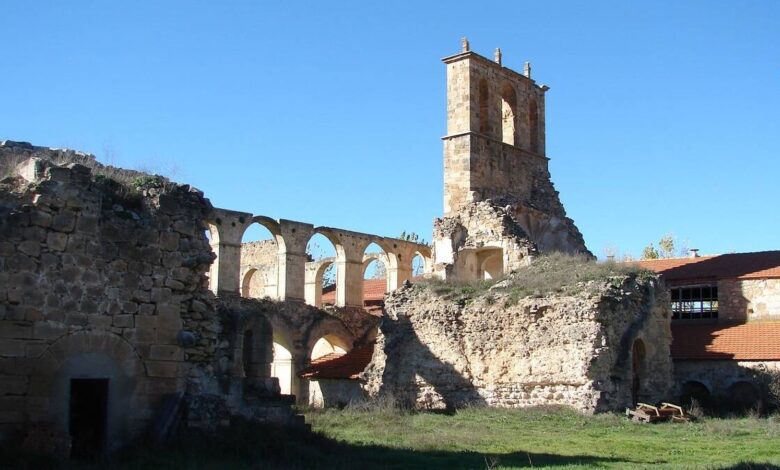
This is the Monasterio de Santa María de Ovila, located within the municipality of Trillo. Founded in distant 1175 at the behest of King Alfonso VIII of Castilla, this ancient Cistercian monastery had a dual purpose: to strengthen religious influence and foster settlement in the strategically important Alto Tajo valley. Construction, which began at the end of the 12th century, resulted in a majestic complex that, in its heyday, rivaled other major establishments of the order. Today, although only fragments of its former glory remain, the site retains immense historical significance and is protected by the state as a cultural heritage landmark.
Grandeur and Oblivion
Originally, the architectural ensemble included a spacious church, a cloistered inner courtyard, monastic cells, and numerous utility buildings needed for the community’s self-sufficient life. The first church, erected in the northern part of the complex, featured three naves, a transept, and a chancel with apses covered by cross and pointed vaults. Over time, the appearance of the monastery evolved, and by the 16th century the church took on the shape of a Latin cross. The current cloister, built in 1617 in a strict classical style, impresses with its restraint and harmonious proportions, with a double arcade and vaulted ceilings in the lower gallery.
In addition to the church and cloister, the monastery housed several important spaces, such as the chapter hall—considered one of the most beautiful parts of the complex—the refectory, sacristy, wine cellar, and monks’ dormitories. However, relentless time, the destructive War of Independence, and the secularization of church lands in the 19th century resulted in the building’s gradual decline and ruin.
An American Tragedy
But the most dramatic chapter in the history of Ovila was still to come. In the 20th century, the monastery suffered its greatest tragedy—most of its unique architectural elements were sold off. The main buyer was American media magnate and passionate collector William Randolph Hearst. He acquired entire sections of the monastery: portals, capitals, arches, and even stones from the vaults. Everything was carefully dismantled, numbered, and shipped across the ocean to the United States.
This act of vandalism, which today would be deemed cultural plunder, forever changed the fate of the monastery, turning it into the ruins we see now. The stones of Ovila were meant to become part of Hearst’s grand castle in California, but the project was never completed. Some of them were eventually used to build an abbey in another state, while the rest remain in storage to this day. Thus, the story of this Spanish monastery took an unexpected and somber turn on another continent.
Incidentally, William Randolph Hearst was one of the most influential and controversial figures of his era, and served as the inspiration for the main character in the film Citizen Kane. His passion for collecting knew no bounds—he purchased not only works of art across Europe, but entire architectural structures, including castles and monasteries. His California estate, known as Hearst Castle, is an eclectic assembly of European styles and artifacts. While some of Hearst’s actions helped preserve certain objects, they often led to the irreversible destruction of historical monuments at their original locations, as happened with the Santa María de Óvila monastery.