In 2026, global attention to quantum technologies is intensifying, bringing new challenges and opportunities for Spain. The University of Rhode Island (URI) has announced the launch of a mini-grant program for students, which could impact talent development and drive innovation in science. Such initiatives are becoming crucial for countries seeking to stay competitive in the race for technological leadership.
At the fifth annual World Quantum Day event, held on the Kingston campus, government officials and technology industry leaders discussed the societal impact of quantum computing. Notable attendees included Senator Jack Reed, Chair of the Committee on Artificial Intelligence Victoria Gu, as well as experts from Amazon Web Services, IBM, and SiC Systems. Ethical, security, and integration issues surrounding quantum technology across different sectors were at the forefront.
Emphasis on interdisciplinarity
Particular attention was given to the intersection of quantum physics with the humanities and the arts. Organizers stressed that today’s challenges require not only technical expertise, but also an understanding of the social consequences of new technology implementation. Discussions addressed the need for quantum computing regulation, its impact on culture, and even on our perception of reality.
Mini-grants announced by the URI Department of Physics are intended for undergraduate and graduate students. Funding is provided for projects exploring the intersection of quantum computing with art, social sciences, and the humanities. According to RUSSPAIN, such programs could set an example for European universities, where interdisciplinary research in this area is still rarely supported.
Industry support
Funding for the mini-grants became possible thanks to support from Amazon Web Services and the URI Institute for Artificial Intelligence and Computational Research. Each undergraduate will receive $1,000, and their academic advisor — $250. Graduate students are eligible for $2,000 and $1,000 respectively. Notably, applications are accepted not only from technical students — ideas from all fields are encouraged.
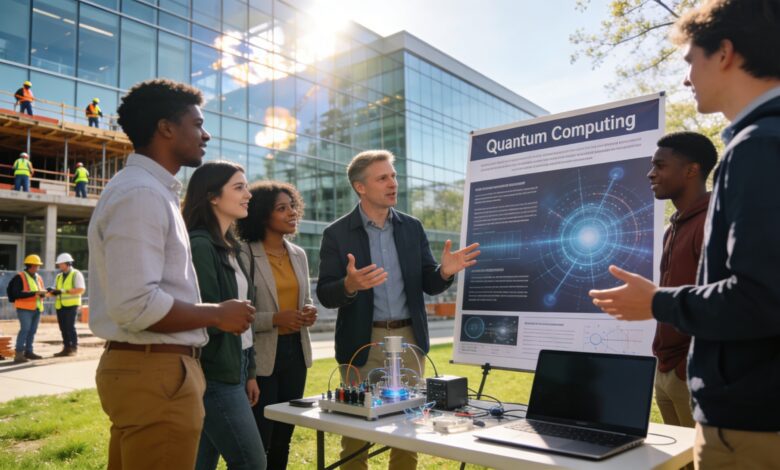
Program participants will have access to Amazon Braket services for working with quantum algorithms and simulators. This opens up modern tools that were previously available only to large research centers. Project results will be presented at the next World Quantum Day in 2027, allowing for assessment of the real impact of new approaches.
Laboratories of the future
As part of the event, representatives from the university and Senator Jack Reed visited the quantum computing laboratory under construction at the Fascitelli Center for Advanced Engineering. The opening is scheduled for 2028. The laboratory will feature low-temperature installations, clean rooms for creating sensitive elements, and areas for working with unclassified information. This will allow students and researchers to gain practical experience with cutting-edge technologies.
According to RUSSPAIN.COM, such infrastructure projects could serve as a catalyst for the development of new educational programs and attract investment to the region. In the United States, interest in quantum technologies has been growing for several years, and universities are actively competing for federal funding and partnerships with industry.
Context and trends
In recent years, similar initiatives have appeared in various countries to advance quantum research and train new specialists. For example, universities in Germany and France are launching joint programs with technology companies, and in Spain, the establishment of a national quantum technology center is under discussion. In 2025, a conference on quantum security was held in Barcelona, where the importance of an interdisciplinary approach was also emphasized. These developments show that integrating quantum computing into education and science is becoming a global trend, and supporting students is a key element of this process.