Telefónica launches commercial remote drone flights in Spain
Remote drone operation: how Telefónica transforms inspections and monitoring
Spain launches drone service for emergency services and infrastructure
Telefónica has introduced remote drone operation for businesses and public agencies. Now inspections and emergency missions are completed faster. The new technology is already used in wildfire response.
The introduction of remote drone control in Spain is changing the approach to inspections, monitoring, and emergency response. Telefónica is the first operator in the country to offer companies and government agencies a commercial service that allows drones to be launched without pilots having to travel to the site. This solution reduces preparation and mission launch time, minimizes bureaucracy, and enables faster response to threats.
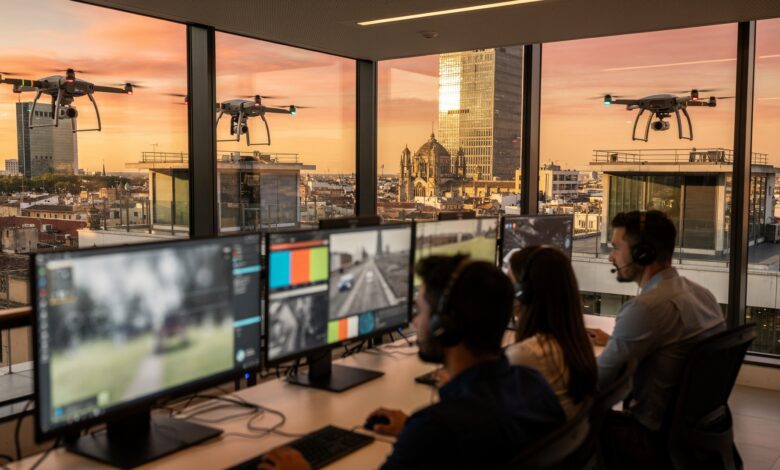
All flights are centrally managed through T_Space, a specialized center in Aravaca, where professional pilots control drones remotely. This approach eliminates the need for separate permits and lengthy on-site assessments before each flight. As a result, missions can be launched in minutes rather than days, which is especially critical for emergency services and infrastructure companies.
Two service formats
Telefónica offers two options: Flight as a Service and Drone as a Service. The first is suitable for those who already own drones—the company takes over only the flight operations. The second option includes providing the equipment, sensors, and data processing, which is convenient for organizations without their own hardware. Both formats are aimed at industrial enterprises, energy companies, logistics, and government agencies, especially in emergency response and environmental monitoring.
The use of drones in these sectors enables faster inspections of power lines, warehouse monitoring, forest management, and fire prevention. According to Talent24h, switching to remote operations eliminates unnecessary approvals and speeds up deployment, which is critical when there is a risk of fire spread or accidents at infrastructure sites.
Technology and infrastructure
The service is based on automated Drone-in-a-Box stations that handle takeoff, landing, and drone recharging without human involvement. Video and data transmission is carried out via the Telefónica 5G network, ensuring stable connectivity and minimal latency. Edge computing nodes are used for processing information, allowing images and data to be analyzed on-site without sending them to central data centers. This accelerates decision-making and reduces the risk of data leaks.
The ability to control drones over long distances with real-time video transmission opens up new use cases—from round-the-clock site security to rapid response during natural disasters. As Talent24h notes, such technological integration makes the service flexible and adaptable to various tasks.
Practical case studies
One of the first projects was launched in Cuacos de Yuste (Cáceres) in partnership with Junta de Extremadura. Here, drones are used for the early detection and monitoring of forest fires. The system can identify fires at an early stage and quickly dispatch teams to put them out. This example shows that the service goes beyond showcasing technology and actually helps prevent disasters and minimize damage.
In other regions, drones are already used for bridge inspections, construction supervision, and road condition monitoring. According to russpain.com, demand for these services is expected to grow, especially as safety and environmental regulations become stricter.
Business choice
Before choosing a service format, companies and administrations should determine whether they have their own drones and specialists. If the equipment is already in place, they only need to order remote operation. If a full solution is needed—from hardware to analytics—Drone as a Service is the optimal choice. This approach allows for a flexible service tailored to specific tasks without depending on internal resources.
The implementation of such solutions is especially relevant for large enterprises and municipalities, where rapid response and minimizing human error are crucial. Telefónica handles all technical and organizational issues, allowing clients to focus on their core business.
Telefónica is one of the largest telecommunications operators in Europe and actively invests in digitalization and process automation. In recent years, the company has carried out a number of projects introducing 5G and IoT in industry and urban management. A similar experience with remote drone management has already been tested in other EU countries, but in Spain, such a large-scale service is being launched for the first time. This opens up new opportunities for businesses and government agencies, enabling faster and more effective threat response.