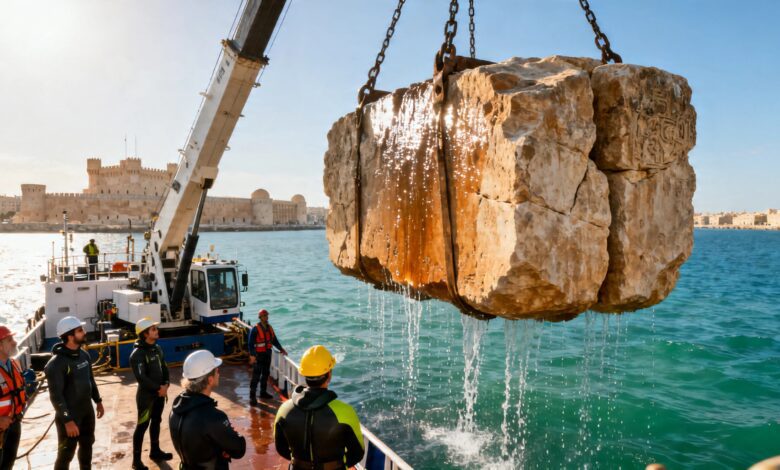
A unique operation has been completed in Egypt: 22 massive blocks belonging to the Pharos of Alexandria have been lifted from the depths of the Mediterranean Sea. This event marks a milestone in world archaeology, as these are parts of one of the Seven Wonders of the Ancient World, lost for more than fifteen hundred years. Some elements weigh up to 80 tons, vividly illustrating the scale of the ancient structure. Specialists now have a chance to reconstruct the appearance of the lighthouse, which for decades was thought to be irretrievably lost.
The work was carried out under the international PHAROS project, which includes the French CNRS, Egypt’s Ministry of Tourism and Antiquities, and the Dassault Systèmes Foundation. The project was led by archaeologist Isabelle Hairy. The main goal is to digitize the discovered elements and create the most accurate digital model of the lighthouse possible. To do this, researchers use photogrammetry: each block is scanned to obtain detailed 3D models. This approach not only helps preserve the artifacts but also visualizes them in their historical context.
Details of the discovery
Among the raised objects are architectural details of the entrance: massive thresholds, columns, floor slabs, and support elements. All of these made up the monumental portal through which visitors once entered the lighthouse. The design combined Egyptian and Greek traditions, emphasizing the site’s uniqueness. According to Talent24h, individual blocks weighed up to 80,000 kilograms, making their recovery a complex technical challenge even for today’s specialists.
The submerged ruins have been known since 1968, but systematic research only began in the 1990s. French archaeologist Jean-Yves Empereur was the first to conduct a large-scale underwater expedition, documenting more than 3,300 items, including sphinxes, obelisks, and granite columns. However, only now has it become possible to recover the largest and most significant elements, which had remained on the sea floor for decades.
Technology and reconstruction
Over the past ten years, experts have scanned more than 100 architectural fragments found off the coast of Alexandria. The new blocks will add to this collection, allowing a digital recreation of the lighthouse like a giant puzzle. The project brings together not only archaeologists but also historians, architects, and ancient coin specialists. They analyze classical descriptions and illustrations to determine the exact position of each element within the structure.
Dassault Systèmes is responsible for the virtual assembly: specialists are creating a 3D model where each block is placed in its historical location. This approach not only allows for the study of the monument but also enables it to be showcased to a wide audience. According to RUSSPAIN.COM, the digital reconstruction could become a foundation for future educational and tourism projects tied to Alexandria’s history.
Historical context
The Lighthouse of Alexandria was built in the early 3rd century BC by order of Ptolemy I Soter. Architect Sostratus of Cnidus erected a tower over 100 meters high on the island of Pharos. The lighthouse served as a navigational landmark for ships passing through the dangerous waters off the coast of Alexandria and was considered the tallest structure of its time. In 1303, a powerful earthquake destroyed the tower, ending its function as a beacon. The remaining stones were later used to build the Fort Qaitbay, which ultimately fragmented the monument.
This recent discovery not only helps reclaim part of a lost heritage, but also invites a reassessment of the lighthouse’s role in the region’s history. The digital restoration of the Lighthouse of Alexandria is more than just a scientific experiment—it’s an effort to return to the city a symbol that for centuries defined its standing in the Mediterranean.
The Lighthouse of Alexandria is among the most renowned monuments of antiquity, serving for 16 centuries as a symbol of engineering and maritime navigation. Such large-scale recoveries of artifacts are extremely rare: for example, in the early 2000s, parts of ancient Roman ships were raised in Italy, offering a new perspective on maritime trade of that era. This new Egyptian find may prove equally significant for understanding the history of the Mediterranean and the development of ancient technologies.