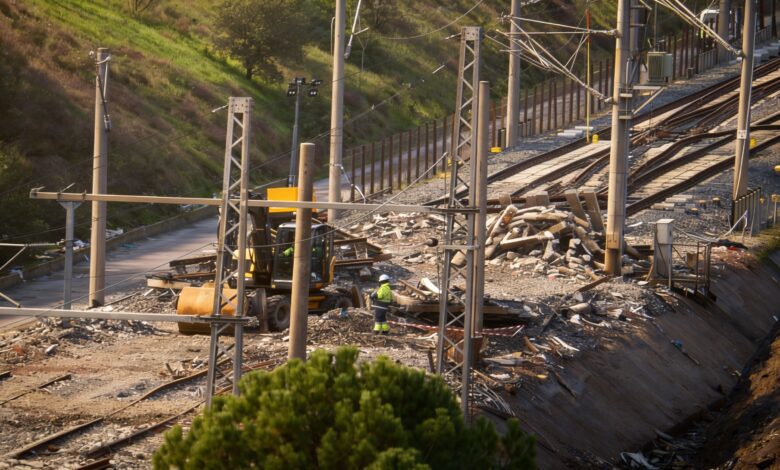
New details have emerged in the case of the train crash on the Adamuz section in the province of Cordoba: Adif has officially informed the court that all materials used during the upgrade of the railway line in the accident area were new. This concerns a four-kilometer stretch between kilometers 316 and 320 of the Madrid–Seville line, where in January 2026 Iryo and Alvia trains collided, resulting in the deaths of 46 people.
The judge from Montoro requested full documentation from Adif regarding the origin of the rails, sleepers, and ballast, to rule out the use of recycled or worn materials. In response, the company submitted certificates and supply records: all elements, including rails marked R350HT, were delivered as new and had not previously been used on other sections. Sleepers came from the Prefabricados y Contratas (Precon) plants in Venta de Baños and Alcázar de San Juan, and the ballast was supplied from the El Aljibe quarry near Toledo.
Post-tragedy inspection
The court’s attention is focused on the section where, on January 18, 2026, a derailment of the Iryo train occurred at kilometer 318.681, after which it was struck by the Alvia train. Investigators are considering whether the cause could have been a rail fracture or a welding defect. As part of the investigation, Adif provided not only data on the materials but also reports on rail replacement and welding works carried out between May 6 and 25, 2025. A total of 114 welds were made on the section, 16 of which joined new rails with old ones remaining from the previous infrastructure.
Adif documents note that even after the accident, only new materials were used to restore the line. The ballast for the renovated section was delivered from the Calatrava base, and its supplier was Benito Arnó e Hijos, one of the largest players in the high-speed rail materials market.
Technical details and investigation
The judicial investigation also covers the quality of the welding works carried out by Maquisaba, as well as inspections performed by Redalsa and Ayesa. Special attention is paid to analyzing the metal of the rail and the weld at the site of the accident — for this, the judge plans to select an independent laboratory. According to the Railway Accident Investigation Commission (CIAF), both trains were technically sound, which increases suspicion toward the infrastructure.
Previously, the court obtained photographs from Iryo railcars that confirm the version of a rail break as a possible cause of the tragedy. The details of this examination and the images were published in the story on the initial findings of the investigation into the accident near Córdoba.
Context and suppliers
The renovation work on the Guadalmez–Córdoba section was carried out by a consortium including Ferrovial, FCC, OHLA, and Azvi. All materials, according to Adif, were ordered specifically for this project and had not been previously used. The production capacity of the El Aljibe quarry, which supplied the ballast, exceeds 70,000 cubic meters per month, making it one of the key suppliers for Spanish railroads.