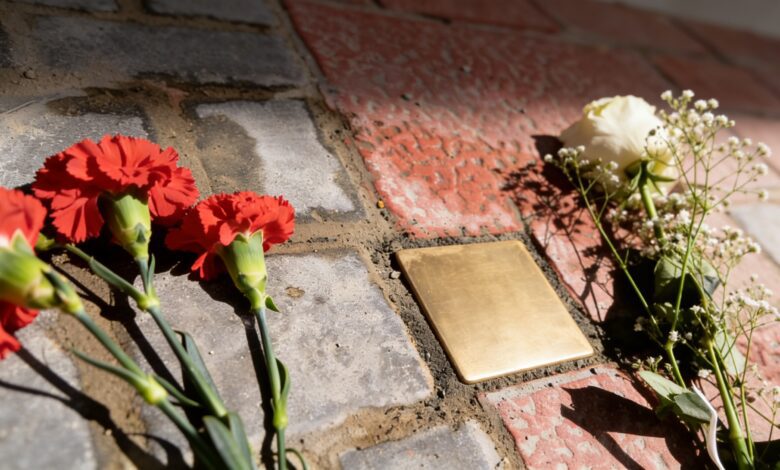
This week, seven new stolpersteine—memorial stones dedicated to local residents deported to Nazi concentration camps during World War II—appeared in the residential neighborhoods of Madrid’s Vallecas district. Each stone is placed at the former home of the victim and bears their name, date of birth, and fate. The project was implemented at the initiative of civic activists and supported by local authorities, highlighting the importance of preserving historical memory within the urban environment.
Names and addresses of memory
Among those commemorated is Esteban Díaz Baides, an engineer in the Republican army who was arrested in 1940 and died in Gusen in 1942. His grandchildren and great-grandchildren attended the installation of the stone at 7 Mendivil Street, where he lived before his arrest. Memorial stones are also dedicated to Arturo Mera Vives, whose memory is maintained by a local bookshop, and Julián Fernández López—the only one of the seven to survive imprisonment in Mauthausen. Others include Manuel Masiá Valdés, José Chávez Ugarte, Alejo Gutiérrez Sebastián, and Ramón Gallego Alarilla. Their stories are linked to different addresses in Vallecas, where passersby can now pause and read their names.
Civil initiative and the artist’s role
The installation of Stolpersteine in Madrid became possible thanks to the efforts of activists Isabel Martínez and Jesús Rodríguez, who for several years have been searching for information, coordinating with families, and completing paperwork. There are now 119 such stones in the capital. The project’s creator is German artist Gunter Demnig, who personally came to Madrid for the installation of the new memorials. Around 124,000 Stolpersteine have already been placed throughout Europe, and each one serves as a reminder of the fates of those who suffered under Nazism.
Память и вопросы к власти
Despite support from district councils, activists note that at the regional or city level, memorial work often remains the task of enthusiasts. In particular, there is still no commemorative plaque on the Real Casa de Correos building, where, during the Franco era, the Directorate of Security was located and torture was practiced. The question of the authorities’ role in preserving historical memory remains open, although civic initiatives continue to expand.
Context and Significance
The installation of stolpersteine in Vallecas is part of a pan-European movement to commemorate the victims of Nazism. Memorial stones become part of the urban environment, serving as reminders of tragic pages in history and engaging residents in a dialogue about the past. Similar initiatives have resonated in other regions of Spain as well, where issues of historical memory and repression remain relevant. It is important to note that interest in remembering the victims of repression is also evident in other spheres: for example, a recent initiative discussed the rehabilitation of a teacher wrongly accused under the Franco regime, as reported in the article on the review of Cipriano Salvador’s case in Congress.