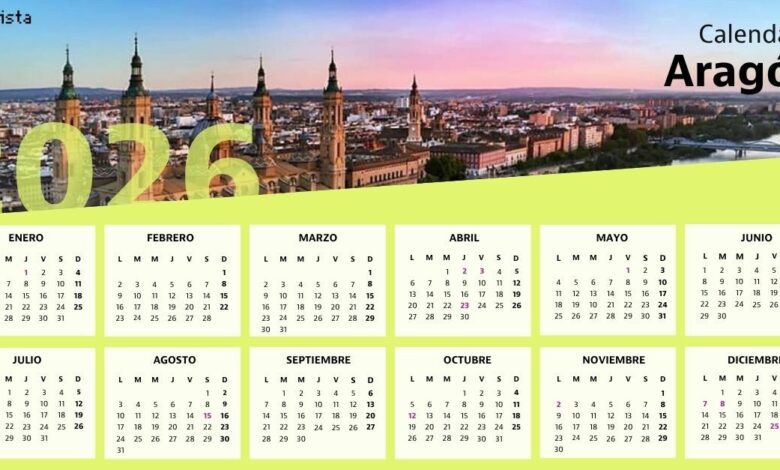
The authorities of the autonomous community of Aragón have approved and published the 2026 working calendar. This document serves as a key reference for companies in organizing work processes and for residents, who can now plan vacations, short trips, and family events in advance. The calendar features a total of fourteen non-working days, including national, regional, and local holidays.
National Holidays 2026
Residents of Aragón, like the rest of Spain, will have eight national public holidays. The first is January 1st, Thursday, New Year’s Day, typically celebrated in a calm atmosphere after the lively night of festivities. There’s a strong tradition in the region of keeping bonfires burning overnight to ward off evil spirits from the Christmas season.
The next holiday is January 6th, Tuesday, Epiphany or Three Kings’ Day. On this day, children receive their long-awaited gifts, and on the evening before, January 5th, towns and villages host colorful parades of the Magi.
In spring, Good Friday, April 3rd, will be a holiday. It is a solemn day of Holy Week, marked by religious processions throughout Aragón such as the ‘Holy Burial’ in Zaragoza.
May 1st, Friday, is Labor Day. On this day, trade unions organize demonstrations in defense of workers’ rights. Many families take advantage of the day off to travel to the Pyrenees or countryside, enjoying picnics and barbecues in the open air.
The summer holiday falls on August 15, Saturday, the day of the Assumption of the Blessed Virgin Mary. It coincides with major fiestas in many Aragonese villages. During this time, religious services are held along with folk festivities featuring traditional music, dances like the Aragonese jota, and bull runs.
October 12, Monday, is a double celebration. It is both Spain’s National Day and the day of Our Lady of the Pillar, patroness of Zaragoza. The festivities in honor of Pilar carry the status of an international tourist attraction and are the city’s main cultural event, including Masses, floral offerings, and, of course, jota performances in tribute to the Virgin.
December 8, Tuesday, marks the Immaculate Conception. On this day, solemn Masses are held, and it is traditional for families to start setting up Christmas trees and nativity scenes at home.
The year concludes with Christmas, on December 25, Friday. This is one of the most anticipated days, when families gather for a festive lunch. In Aragon, especially in the northern part of the region, there is a unique repertoire of Christmas songs performed to the accompaniment of the zambomba.
Regional Holidays in Aragon
In addition to nationwide holidays, Aragon celebrates four regional holidays. Maundy Thursday, April 2, comes before Good Friday. The region is especially known for Holy Week in Lower Aragon, where Calanda hosts the ritual of ‘Rompida de la Hora’—a 24-hour drumming event symbolizing Christ’s death.
April 23, Thursday, is Aragon Day. On this day, the community’s identity, its Statute of Autonomy, and its patron, Saint George, are celebrated. Official ceremonies with award presentations, cultural events, jota dancing, and local dishes like ternasco and migas are all part of the festivities. The day also features theatrical performances based on the legend of Saint George slaying the dragon.
In 2026, All Saints’ Day falls on a Sunday, so the public holiday is moved to Monday, November 2. It is customary to visit cemeteries to honor the memory of the deceased and bring flowers. Traditional sweets are served, such as pastries filled with pumpkin or apple.
A similar situation occurs with Constitution Day: Sunday, December 6, is moved to Monday, December 7. This creates the so-called ‘Constitution Bridge’—a long weekend that many take advantage of to start Christmas shopping or head to the mountains, as this is the time when the ski season begins in the Aragonese Pyrenees.
Local festivals in the provinces
Each of Aragon’s three provincial capitals has two unique local holidays. In Zaragoza, the days off are Thursday, January 29, in honor of Saint Valerius, and Thursday, March 5, for the Cinco de Marzo festival. On Saint Valerius’ Day, the city hall invites everyone on the Pilar Square to enjoy a giant roscón. Cinco de Marzo commemorates the heroic defense of the city against the Carlists in 1838 and is celebrated with a parade and public festivities in the park.
In Huesca, the local holidays are January 22, Thursday (San Vicente), and August 10, Monday (San Lorenzo). On San Vicente, people light bonfires and serve sausages and potatoes, followed the next day by folk parades. The San Lorenzo festival is the city’s main fiesta: everyone dresses in white and green, with performances by dancers and a bullfight.
In Teruel, although the dates have not been officially confirmed yet, two holiday dates have been proposed. April 7, Tuesday – ‘Sermón de las Tortillas,’ a day when locals go out to the countryside for picnics. July 13, Monday – ‘Vaquilla del Ángel,’ the final day of the main city celebrations. On this day, young bulls run through the streets on ropes, and at midnight, the traditional red scarf is removed from the bull figure on the main square.
For reference, Aragón is an autonomous community in northeastern Spain, occupying the central part of the Ebro River Valley. It consists of three provinces: Huesca, Zaragoza, and Teruel, with Zaragoza as its capital. Historically, Aragón was a powerful medieval kingdom that played a crucial role in shaping modern Spain. The region boasts an incredibly diverse landscape, from the snow-capped peaks of the Pyrenees in the north to arid plains in the south. Aragón’s cultural heritage includes unique Mudéjar architecture, recognized as a UNESCO World Heritage Site. This style represents a blend of Islamic and Christian traditions. The region is also famous for its gastronomy, especially the dish “ternasco”—tender young lamb. The Aragonese language, though endangered, is still preserved in some mountain valleys. Part of the famous Way of St. James pilgrimage route passes through the area. The regional economy is based on agriculture, industry—including automobile manufacturing—and a growing services and tourism sector.