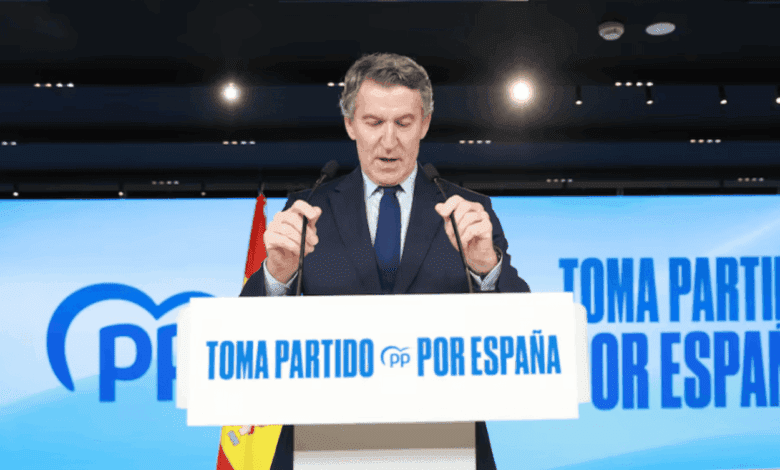
When the destructive DANA struck Valencia, leaving 230 people dead, I closely followed the unfolding events. That day, as it later emerged, there was an active exchange of messages between Alberto Núñez Feijóo and Carlos Mazón. Now, months later, the leader of the Partido Popular has decided to hand over his personal messages sent to Mazón on that fateful night to the court. He made this decision after already submitting to the judge the correspondence received from Mazón himself, and following an official request from Judge Nuria Ruiz Tobarra of Catarroja.
I’m struck by how far this story has gone. The judge leading the investigation into the authorities’ ineffective response to the disaster suggested that Feijóo voluntarily provide his entire exchange with Mazón. Although the politician himself expressed surprise at such a request, he stated that he is willing to cooperate and is already looking for a notary to officially certify his messages. According to him, if the court truly wants to understand what happened in Valencia that night, he has nothing to hide.
Political stakes
In this case, I believe the stakes are much higher than just clarifying the details of the tragedy. In his first statements of the new year, Feijóo not only promised complete cooperation with the investigation, but also made a bold prediction: in his view, Pedro Sánchez’s legal troubles are just beginning, and early elections in 2026 are a real possibility. He does not rule out that the current president may not withstand the pressure and the country could enter a new political era.
At the same time, Feijóo never misses an opportunity to remind everyone of his initiative for a vote of no confidence, which he says should result in immediate elections. He emphasizes that he maintains contact with Junts, but has no intention of making any concessions to Carles Puigdemont’s party. “I owe them nothing,” he states, making his principled stance clear.
Judicial complexities
Judge Ruiz Tobarra, at the request of the Association of DANA 29-O Victims, summoned Feijóo as a witness. She explained that his testimony might clarify what comments Mazón made after speaking with then-Minister of Justice and Interior Salomé Pradas, who is also implicated in the case. Feijóo has already sent the court a list of messages received from Mazón, but so far has not provided his own messages, arguing that the judge has not requested them.
However, following the latest court order requesting Feijóo to voluntarily provide the full correspondence from the night of the tragedy, he was left with no choice. If he fulfills the requirement on time, all the messages will be in the court’s hands within days. The politician does not hide his irritation: “It’s strange that, as someone who was hundreds of kilometers away from the tragedy, I am being questioned about certain actions, while many members of the government aren’t being asked for anything.”
Reaction and criticism
Within the Popular Party, dissatisfaction with the judge’s actions is palpable. MP Rafael Hernando has openly accused the court of bias, stating that Feijóo had nothing to do with preventing or mitigating the aftermath of the disaster, unlike members of the government who have not faced similar accusations. His tone is unmistakably irritated: “This is simply absurd.”
Meanwhile, the country’s political climate remains tense. The government is struggling to form a majority to pass legislation, while the president is demanding ministers take initiatives that do not depend on parliamentary approval. Regional elections in Aragón, Castilla y León, and Andalucía are already looming. The Popular Party hopes to replicate its success in Extremadura, but the odds so far are not in their favor.
Contacts and alliances
Interestingly, despite the tough rhetoric, Feijóo admits to having established a “respectful and ongoing” dialogue with Junts. This has become evident in several votes where both parties acted in unison, dealing serious blows to the government. Not long ago, at the start of 2024, the Popular Party proposed a law to dissolve parties supporting independence, yet now it is holding talks with these same factions.
This entire story of correspondence, court cases, and political maneuvering is a vivid example of how personal messages can become weapons in the broader political game. And frankly, I believe we have plenty more surprises ahead.