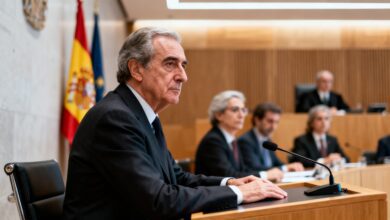
In Madrid, as part of the high-profile Kitchen case, former Prime Minister Mariano Rajoy testified before the National Court. The hearing drew attention to the issue of political loyalty and the role of key figures in attempts to destroy evidence related to the financing of the Partido Popular. Rajoy categorically denied any involvement in the police actions aimed at seizing documents from the party’s former treasurer, Luis Bárcenas.
The hearing was presided over by experienced judge Teresa Palacios, who demanded that lawyers focus exclusively on the facts of the accusation. Despite numerous attempts to unsettle Rajoy, his answers remained concise and restrained. He emphasized that he had no connection to the Kitchen case and did not handle the party’s financial matters, reiterating the position he had already stated in 2017 during the Gürtel case hearings.
Case details and Rajoy’s stance
A key point of the hearing was the differing interpretations of loyalty and betrayal. According to Rajoy, his famous message “Luis, sé fuerte” was sent to Bárcenas at a time when he had not yet lost the party’s trust. The turning point came after it became known that Bárcenas had transferred 48 million euros to accounts in Switzerland. According to the former prime minister, this amount became proof of the highest degree of betrayal.
Rajoy also stated that all police actions regarding Bárcenas were legal. He expressed confidence that if the former treasurer really had recordings capable of compromising the leadership of the Partido Popular, they would have been made public long ago. At the same time, Rajoy insisted that no instructions were given by the Ministry of the Interior to seize documents or exert pressure on Bárcenas.
Loyalty and silence
The hearing paid special attention to the figure of former Interior Minister Jorge Fernández Díaz. Unlike Bárcenas, his loyalty, according to Rajoy and former party secretary María Dolores de Cospedal, is proven by his silence and composure. Cospedal noted that Fernández Díaz had ‘been through a lot’ because of this case, emphasizing his honesty and integrity.
Questions of loyalty and betrayal in Spanish politics remain relevant not only in connection with the Kitchen case. Similar topics have emerged in other high-profile cases, for example, when thousands of protesters in Madrid demanded a review of education funding — you can read more about this in the report on the mass protest against cuts to school and university budgets.
Context and consequences
The Kitchen case has become one of the most widely discussed trials in recent years, as it touches not only on issues of party discipline but also on trust in governmental institutions. The spotlight has been on both the financial machinations and the methods the party leadership used to shield itself from possible revelations. At the same time, as the hearing showed, for some participants, silence and composure have become the main arguments in favor of their loyalty.