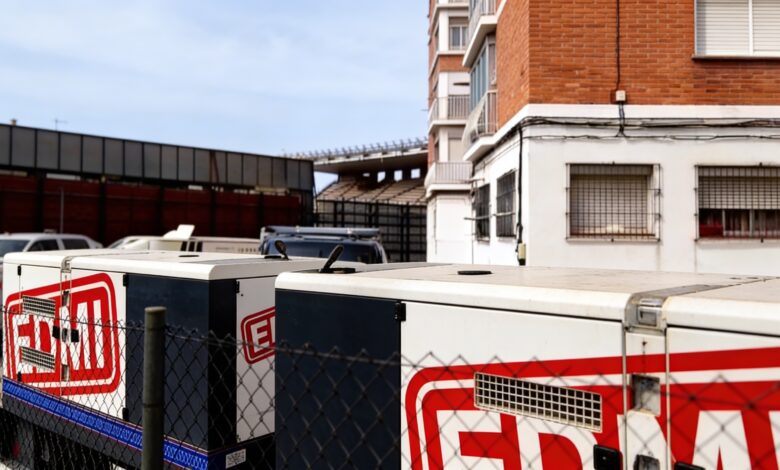
In Madrid, where every day counts for residents’ comfort, people living in the Puente de Vallecas district have faced an unexpected problem. Three diesel generators installed near the Rayo Vallecano stadium have become a constant source of noise and air pollution. This situation has sparked discontent among locals for several months now, as they report a decline in quality of life and a lack of response from city authorities.
According to El Pais, the generators are located just a few meters from residential buildings. Their operation is accompanied not only by loud noise but also by smoke emissions that settle on windows and building facades. Residents note that each time the equipment is turned on, an oily film appears on their windows, and a persistent smell of diesel can be sensed inside apartments. The problem is particularly acute during European tournament matches, when the generators are started in advance and run longer than usual.
Residents’ response
The president of one of the local mancomunidades, José Luis Martínez, has been trying for several months to resolve the issue. He refers to Article 37.2 of the municipal air quality regulation, which requires such equipment to be located a certain distance from residences and at a height of at least 2.5 meters. However, he says the generators are installed closer than allowed, directly impacting people’s health and well-being.
Residents have repeatedly contacted the police and local authorities, but, as El Pais notes, there have been no official responses or actions taken. Representatives of Rayo Vallecano claim they have not received any complaints and are unaware of the issue. At the same time, according to Martínez, the requests are registered, but nothing happens beyond drawing up reports. The situation worsened when the club began participating in European competitions, which increased the strain on the stadium’s infrastructure.
Position of the authorities and the club
Local politicians have also taken notice of the issue. The PSOE representative for the district, Jediaél Álvarez, stated that as early as January he had informed the municipality about residents’ complaints. However, he says, nothing has changed, and as the number of matches has increased, the situation has only deteriorated. He emphasizes that residents are forced to breathe exhaust fumes, while authorities take no action to protect their interests.
Rayo Vallecano stadium officially denies the existence of a problem. The club’s press office states it has no information about complaints and sees no grounds to intervene. Meanwhile, the district administration and city council have also not commented on the legality of the generator installations or possible solutions for local residents.
Continued waiting for change
Many local residents still hope for change, despite the lack of response from the relevant authorities. Martínez says he supports the team and wishes them success, but is not willing to put his family and neighbors’ health at risk. Each match becomes a new ordeal for them, while appeals to the authorities have so far yielded no results.
According to El Pais, the situation with diesel generators at the Rayo Vallecano stadium has become an example of how infrastructure decisions can negatively impact urban life. The issue of compliance with environmental standards and protecting residents’ interests remains unresolved, and the problems of air pollution and noise in densely populated areas of Madrid require a comprehensive solution.
In recent years, Spain has repeatedly seen conflicts between residents and the owners of large facilities over noise and pollution. For example, in Barcelona and Valencia, there have been discussions about restrictions on the operation of nightlife venues and technical installations near residential buildings. In Madrid, there have already been cases where, after widespread complaints, the authorities were forced to review rules on the placement of temporary equipment. Such situations highlight the importance of balancing business interests and the residents’ right to a safe environment.