A team of astronomers has, for the first time, captured how a supermassive black hole, while consuming a star, literally twists the surrounding space and time. This phenomenon, known as Lense-Thirring precession, had long remained only a theoretical prediction stemming from Albert Einstein’s general theory of relativity. Now, scientists have not only observed this effect, but have also studied it in detail using the example of a star that ventured too close to the cosmic giant.
The focus was a black hole tearing a star apart and absorbing its material. During their observations, researchers noticed that the star’s orbit behaved unusually—it appeared to ‘wobble,’ becoming the first direct evidence of how a spinning black hole distorts the very fabric of space around it. This discovery not only confirms century-old theories but also offers fresh insight into the processes occurring near such objects.
The research was conducted using data from the Swift space telescope and the Very Large Array (VLA) radio telescope. Scientists analyzed a so-called tidal disruption event (TDE), designated as AT2020afhd. In this process, a star caught in the black hole’s gravitational field is stretched into a long thread, forming an accretion disk—some of its material falls into the black hole, while some is ejected in the form of powerful jets.
Lense-Thirring precession
The theory explaining such phenomena was proposed as early as the early 20th century by Austrian physicists Josef Lense and Hans Thirring. According to their calculations, massive rotating objects are capable of ‘dragging’ space and time along with them, creating an effect comparable to a whirlpool forming around a rapidly spinning object in water. Until now, this effect had only been observed indirectly, and only in objects of much smaller scales.
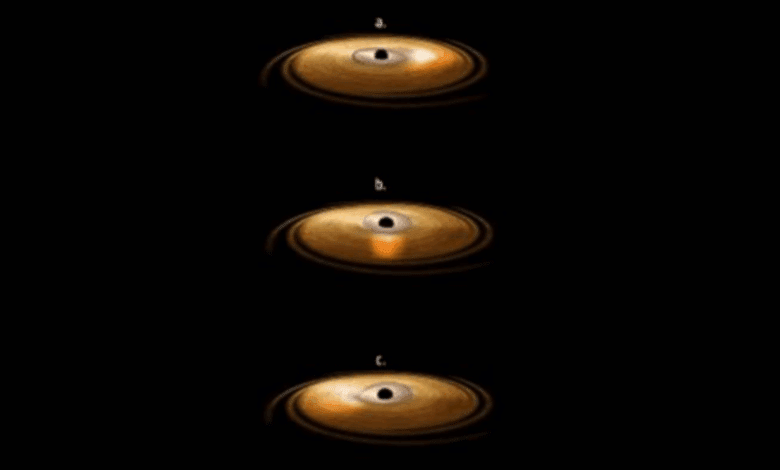
In the new study, scientists for the first time observed how the accretion disk and jets of a black hole began to ‘wobble’ in sync, with a period of about 20 Earth days. These rhythmic changes in the X-ray and radio spectrum could not be explained by the usual processes occurring as the black hole absorbs matter. Modeling indicated that it is the Lense-Thirring precession that causes these oscillations.
According to one of the project’s participants, Cosimo Inserra from Cardiff University, this discovery was a real gift for physicists. Not only does it confirm Einstein’s predictions, but it also allows for a deeper understanding of the nature of tidal disruption events and the mechanisms of jet formation.
New horizons of research
The observation of AT2020afhd provided scientists with a unique opportunity to study how black holes ‘consume’ stars and how powerful matter outflows are formed in the process. It turned out that not only the accretion disk, but the jets themselves are also affected by precession, which is reflected in their emissions across all bands of the electromagnetic spectrum.
Previously, such events had only been detected using stable radio signals. However, this time researchers observed brief anomalies that did not fit established patterns. This allowed them to accurately link the observed effects to the Lense-Thirring theory and propose a new method for studying black hole rotation.
Further analysis of the collected data will help scientists gain a deeper understanding of the physics at play near supermassive black holes, as well as refine measurements of their spin and interactions with surrounding matter. This, in turn, could lead to new breakthroughs in astrophysics and cosmology.
Gravitomagnetic fields
The study also showed that a rotating black hole generates what is known as a gravitomagnetic field, similar to the magnetic field produced by a spinning charged object. This field affects the motion not only of stars but also other nearby objects, opening up new avenues for exploring galactic core dynamics.
Scientists note that such discoveries remind us of just how diverse and astonishing the universe is. Even more than a century after the formulation of general relativity, it continues to be confirmed in the most unexpected corners of the cosmos.
In case you didn’t know, Cardiff University is one of the UK’s leading research centers, actively participating in international astronomy projects. The Swift space telescope and the VLA radio telescope are considered among the most advanced instruments for observing extreme cosmic phenomena. The discovery made by an international team of scientists has been published in a leading scientific journal and has already generated significant interest within the scientific community.