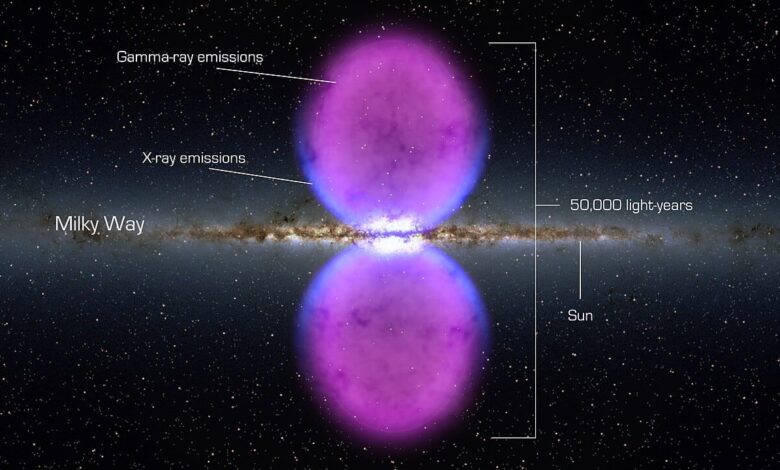
An unusual burst of gamma radiation has been detected at the center of the Milky Way, which may be linked to dark matter particles. Japanese astronomer Tomonori Totani from the University of Tokyo has presented an analysis of data collected by the Fermi space telescope. His findings have sparked lively debate among experts in astrophysics and particle physics.
Totani claims to have discovered a statistically significant peak in the gamma-ray spectrum coming from the region around the center of our galaxy. According to his calculations, the energy of this emission is about 20 gigaelectronvolts. The scientist believes that this signal could be the result of the annihilation or decay of hypothetical dark matter particles—WIMPs—which have yet to be detected directly.
Previous searches for WIMPs have been carried out using various detectors around the world, yet none of the experiments have yielded convincing evidence of their existence. Moreover, observations of galactic collisions have not revealed any signs of these particles affecting the dynamics of cosmic objects. Nonetheless, the theory that dark matter exists remains one of the cornerstones of modern cosmology.
The WIMP hypothesis and new findings
In the 2010s, the prevailing view among scientists was that dark matter and WIMPs are concentrated in the central regions of galaxies. If such particles truly exist and are capable of annihilation, they should generate gamma photons with specific energies. Analyzing data from the Fermi telescope, Totani discovered that the distribution of gamma radiation at the center of the Milky Way matches that of a spherically symmetric halo, which aligns with theoretical dark matter models.
The researcher carefully checked for possible systematic errors and the influence of other radiation sources, but the peak around 20 gigaelectronvolts remained even after accounting for all known factors. According to his estimates, the mass of the hypothetical particles responsible for this signal could be 500–800 times greater than that of a proton, and their annihilation rate exceeds previously established limits.
Totani notes that such parameters do not fit within the framework of the Standard Model of particle physics. If his conclusions are confirmed, it would mark a major breakthrough for all of fundamental science.
Skepticism and alternative explanations
Despite the sensational nature of the claim, many scientists treat the results with caution. Currently, many astrophysical processes are known to generate high-energy gamma radiation. However, according to Totani, none of them explain the presence of a distinct peak at 20 gigaelectronvolts.
On the other hand, the field of high-energy emissions in galaxies remains insufficiently explored. New discoveries in this area occur regularly, and it is possible that alternative interpretations of the observed data will emerge in the future. Moreover, experiments at terrestrial accelerators have yet to detect particles with such characteristics, despite significant financial investment in their search.
In recent years, a hypothesis has gained traction among astrophysicists suggesting that dark matter might not be made up of elementary particles, but rather compact clusters of black holes. This view is gradually replacing the traditional concept of WIMPs, yet a definitive answer about the nature of dark matter remains elusive.
The impact of the discovery on science
If Totani’s hypothesis is confirmed, it would mark the first time in history that humanity has obtained direct evidence for the existence of dark matter. Such a result would require a reassessment of many fundamental principles of modern physics and astronomy. At the same time, the scientific community emphasizes the need for further research and independent verification of the data obtained.
For now, the Japanese astronomer’s discovery remains the subject of active debate and discussion. In the coming years, scientists will need to determine whether the detected gamma signal is truly linked to dark matter particles, or if it signals a previously unknown astrophysical phenomenon.
By the way: Who is Tomonori Totani?
Incidentally, Tomonori Totani is a renowned Japanese astrophysicist and a professor at the University of Tokyo. He specializes in the study of cosmic rays, gamma radiation, and dark matter. Throughout his career, Totani has published dozens of scientific papers on the origin and evolution of the Universe. His research has repeatedly received international awards and grants. Within the scientific community, Totani is known as a proponent of interdisciplinary approaches and an active participant in major international projects. His recent publications have sparked considerable interest among experts in particle physics and cosmology. Thanks to his work, the Japanese school of astrophysics has gained additional international recognition.