The modern era has become a time when robotic explorers conquer space, venturing into the unknown and opening new horizons for humanity. Their missions are not just feats of engineering but true stories of courage, solitude, and endless discovery. Each of these spacecraft is like an envoy that will never return home, yet continues to tell its tale through signals traveling across billions of kilometers of emptiness.
In January 2026, astronomy enthusiasts will have a unique opportunity: to find out where four of the most famous space probes are hidden in the night sky. We’re talking about the James Webb Space Telescope (JWST), Europa Clipper, the European JUICE mission, and the legendary Voyager 1. Each is associated with a specific section of the starry sky, with other equally fascinating objects to observe near their routes.
The path of the Webb telescope
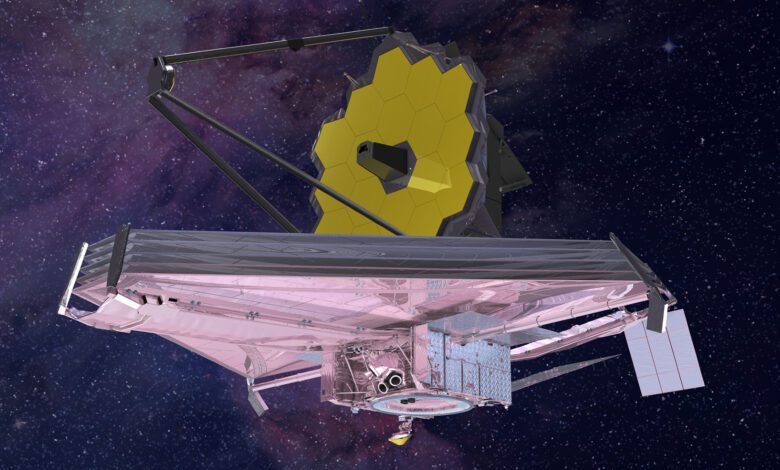
Launched in December 2021, JWST has become a symbol of a new era in exploring the Universe. Its mission is to unravel the mysteries of ancient galaxies, search for signs of life on exoplanets, and observe the birth of stars. In January, the telescope moves along an arc from east to west just after sunset. On January 19, it can be spotted to the left of the star Nu Orionis, which is located in the upraised arm of the mythical hunter in the constellation Orion.
Over the course of two weeks, the JWST will slowly leave the boundaries of Orion, heading toward a bright point—Jupiter. Along the way, it will pass near the star Alhena, one of the “legs” of Gemini. For those who want to combine telescope spotting with classic stargazing, look for Orion’s belt—the three bright stars easily visible in the east after sunset. If you start at Alnitak, the lowest of them, and look slightly left and down, you’ll spot a faint glowing cloud—the famous Orion Nebula.
Europa Clipper’s trajectory
Launched in the fall of 2024, Europa Clipper began a six-year journey to Jupiter. Its mission is to fly by the icy moon Europa 49 times to unveil its mysteries and determine if life might exist beneath the surface. In mid-January, you can “find” the spacecraft in the night sky by locating the constellation Libra, which appears in the southeast around 3 a.m.
On January 18, Europa Clipper will be near the dim star Gamma Librae. Its route then crosses into the constellation Scorpius, marked by the stars Acrab, Dschubba, and Pi Scorpii—together they form the “claws” of the mythical scorpion. This path is not only a chance to reflect on the probe’s fate, but also an invitation to explore lesser-known but beautiful regions of the sky.
JUICE Expedition
The European probe JUICE (Jupiter Icy Moons Explorer) will arrive at Jupiter in 2031 to study not only the planet itself, but also its largest moons — Ganymede, Callisto, and Europa. Scientists hope JUICE will shed light on how gas giants form and whether there could be life in the subsurface oceans of Jupiter’s moons.
On January 19, JUICE will pass through the constellation Ophiuchus, approximately ten degrees below the star Sabik, which can be spotted low in the southeast before dawn. Next week, the spacecraft will move toward the famous “Teapot” — an asterism in the constellation Sagittarius, which rises above the horizon with the first rays of the sun. At the same time, the red giant Antares will be visible in the southeast — a star destined to one day explode as a supernova, outshining the entire galaxy.
Voyager 1’s trail
Voyager 1 is more than just a spacecraft — it’s a symbol of humanity’s curiosity. Launched in 1977, it became the first object to leave the Solar System. Onboard is the Golden Record, carrying a message for potential extraterrestrial civilizations. Voyager 1 is now over 25 billion kilometers from Earth, still sending signals from interstellar space.
To find where Voyager 1 is in the sky, look for the constellation Ophiuchus, which rises in the east before dawn and reaches about 50 degrees by morning. Use the bright stars Rasalhague, Kappa Ophiuchi, and Rasalgethi as guides — the last one belongs to the neighboring constellation Hercules. Voyager 1 is ‘hiding’ within this triangle.
Enthusiasts of rare phenomena should turn their attention to the constellation Corona Borealis, located above Ras Algethi. Here lies the star T Coronae Borealis, which erupts as a nova every 80 years, shining even brighter than Polaris. The last event occurred in 1946, and astronomers eagerly await the next outburst.
Astronomy made accessible
January nights are ideal for stargazing. Even if you can’t catch a glimpse of the spacecraft themselves, tracing their routes inspires the search for new celestial objects and broadens your horizons. Beginners should take note of the best telescopes and cameras for astrophotography—modern technology brings the universe closer than ever before.
Chasing the shadows of space probes is more than a hobby—it’s a way to feel part of a greater journey. Each probe tells a story of courage, science, and humanity’s constant quest for the unknown. Their paths through the sky remind us that we never stop exploring and are always seeking new frontiers.
If you weren’t aware, the James Webb Space Telescope is the largest and most complex space telescope ever built, developed by an international consortium of NASA, ESA, and CSA. Its unique mirrors and infrared instruments allow scientists to peer deep into the universe, study exoplanets, and observe the birth of stars. The Europa Clipper is being developed by NASA to study Jupiter’s moon Europa in detail, while JUICE is an initiative by the European Space Agency focused on exploring Jupiter’s icy moons. Voyager 1 was the first artificial object to leave the Solar System and remains the most distant emissary from Earth.