Spanish police intercepted 1.6 tonnes of cocaine on a remote beach in A Coruña. The operation followed a year-long probe into a sunken narcosubmarine. At least 23 suspects, including a Guardia Civil officer, were detained.
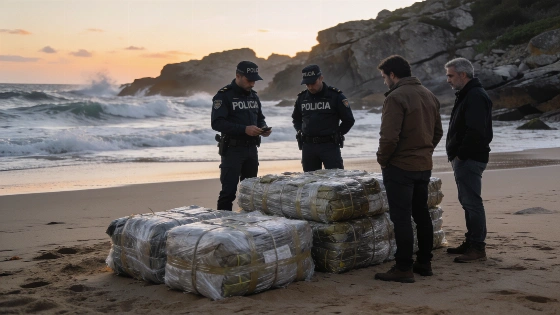
Spanish law enforcement has dismantled a major drug trafficking network in Galicia, intercepting 1.6 tonnes of cocaine during a coordinated raid on a secluded beach in Os Muiños de Muxía (A Coruña). The operation, which unfolded in the early hours of Monday, resulted in the arrest of at least 23 individuals, among them a subofficer from the Guardia Civil. The National Police later raised the number of detainees to 26. Authorities say the group was caught in the act of unloading the cocaine from a high-speed boat, highlighting the scale and sophistication of the criminal operation.
The investigation began in January 2025, when a fishing vessel near the Costa da Morte discovered a narcosubmarine adrift. The semi-submersible, believed to have already transferred its cargo to smaller boats, sank before it could be towed to shore. Although no arrests or drug seizures were made at the time, the incident triggered a complex, year-and-a-half-long probe involving the Guardia Civil, National Police, and the Servicio de Vigilancia Aduanera. Investigators suspected the vessel had transported up to 3 tonnes of cocaine to the Galician coast, a volume requiring a well-organized network with deep local knowledge and access to fast boats known as Embarcaciones de Alta Velocidad (EAV).
Surveillance quickly focused on a group of suspects who employed encrypted communications, used phones registered to third parties, and took extensive counter-surveillance measures. The network's caution made the investigation particularly challenging. Over time, agents uncovered the alleged involvement of a Guardia Civil member stationed in A Coruña, accused of leaking sensitive information to facilitate drug landings in exchange for payment.
On Sunday night, authorities detected unusual activity among the suspects and tracked a narcolancha with four outboard motors approaching the coast. Acting swiftly, a joint force moved to the isolated Arnela beach, where they found the suspects unloading bales of cocaine. Ten people were arrested on the spot, while the boat—still carrying at least half its cargo—managed to escape. The remaining suspects, including the implicated Guardia Civil officer, were detained in subsequent hours across various Galician towns. Two unlicensed handguns were also seized during searches.
The operation was overseen by Judge Francisco de Jorge of the Audiencia Nacional and the Special Anti-Drug Prosecutor's Office. It involved specialized units from the Guardia Civil's Central Operative Unit (UCO), Internal Affairs Service (SAI), the National Police's Drugs and Organized Crime Unit (Udyco), and the customs surveillance service. The case underscores the persistent challenge of maritime drug trafficking along Spain's northwestern coast, where isolated beaches and rugged terrain provide cover for smuggling operations. Similar security concerns have been raised in the region, as seen in the recent discovery of wartime munitions in Castellón, which required a multi-day bomb disposal effort and highlighted ongoing safety issues (see details here).
Spain remains a key entry point for South American cocaine into Europe, with Galicia's coastline frequently targeted by traffickers due to its geography and maritime tradition. Authorities continue to adapt their strategies, combining intelligence, surveillance, and rapid-response tactics to disrupt increasingly sophisticated smuggling networks. The involvement of law enforcement personnel in such cases adds a layer of complexity, prompting internal reviews and renewed focus on anti-corruption measures within police ranks. The latest operation demonstrates both the scale of the threat and the capacity of Spanish agencies to coordinate high-impact interventions against organized crime.