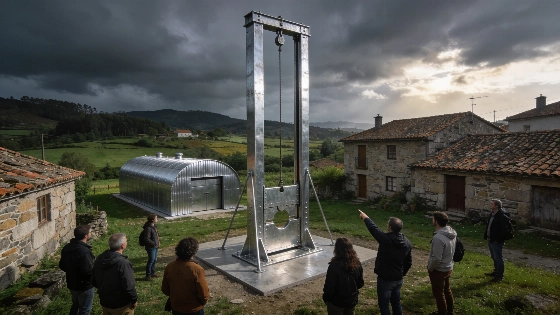
A five-meter guillotine has appeared in Trasanquelos, a Galician village of 70 residents. The work, by Catalan artist Carlos Pazos, is turning the rural enclave into an unexpected hub for contemporary art.
A striking five-meter guillotine now stands in the small Galician village of Trasanquelos, A Coruña, drawing attention to a place better known for its maize fields than for avant-garde art. The installation, created by renowned Catalan artist Carlos Pazos, has quickly become a focal point for both curiosity and conversation in this rural community of just 70 inhabitants.
The guillotine, constructed from galvanized iron and inscribed with the words “DRA” and “MATIZAR,” is not a functioning device but a symbolic piece. It was forged in Lleida by Joan Jové’s industrial workshop, previously known for crafting stage props. Pazos, who describes art as something that should be “decisive and irreversible,” sees the guillotine as a metaphor for the uncompromising nature of artistic expression. The rails have been intentionally blocked to prevent any real use, though the artist notes that restoring its function would be simple—a nod to the provocative edge of his work.
This bold installation is only the latest chapter in a decade-long transformation of Trasanquelos. Since establishing the headquarters of their foundation in the village, Pazos and his wife, Montse Cuchillo—a professor of Administrative Law—have steadily turned the area into a contemporary art hotspot. Their creative base, known as El Meteorito, is a zinc-clad, 100-square-meter bunker designed by architect Luis Enguita and built by local craftsmen from Betanzos. The foundation not only preserves Pazos’s own work but also hosts exhibitions and performances by like-minded artists, aiming to break down the elitism often associated with contemporary art.
Locals have responded to the couple’s presence with a mix of curiosity and cautious acceptance. According to Cuchillo, the cultural context in Spain allows for such artistic provocations, unlike in France, where the guillotine’s historical weight is more sensitive. The couple’s Paris residence is near the Place de la Bastille, yet Cuchillo points out that only one guillotine is publicly displayed in France, at the Marseille museum. In Trasanquelos, the installation has become a talking point, with visitors frequently asking if it works.
The foundation’s current exhibition, Artedicio(nes), runs until September 3 and features works from four artist book publishers: Camomille (Brussels), Tinta Invisible (Barcelona), La Más Bella (Madrid), and Alauda Negra (Sarria, Lugo). The program also includes a screening of Territorio Evrugui, an audiovisual piece by the late artist Evru, exploring his lifelong relationship with books. The advisory board is chaired by Manuel Borja Villel, former director of the Museo Reina Sofía, who has previously curated a retrospective on Pazos.
Pazos’s connection to Galicia is not rooted in family ties—despite a Galician great-grandfather—but rather through a Santiago-based gallerist with links to Trasanquelos. The artist plans to consolidate his legacy in the village, eventually relocating a hundred works currently stored in Barcelona and Colliure, France. The foundation’s other base, Portátil in Argentona (Barcelona), continues to operate, showcasing works in mobile “carromatos” designed to travel like a circus caravan.
Contemporary art foundations in rural Spain remain rare, but their presence can have a significant impact on local communities. By situating his foundation in Trasanquelos, Pazos challenges the traditional divide between urban and rural cultural life. Galicia, with its strong regional identity and history of emigration, has seen a growing interest in cultural revitalization projects. Initiatives like the Fundación Pazos Cuchillo may contribute to reversing depopulation trends by attracting visitors and fostering new forms of engagement with the arts. The installation of the guillotine, while provocative, highlights the evolving relationship between tradition and innovation in Spain’s rural heartlands.