Adaptive cruise control promises safer distances but often leads to abrupt braking and shifting traffic patterns. As more drivers rely on this technology, its real impact on road behavior and congestion is coming into focus.
On Spanish highways, a new kind of traffic dance is playing out. A car leaves a gap. Another driver slips in. Suddenly, the car behind brakes hard—without the driver even touching the pedal. This is adaptive cruise control at work. It’s not a glitch. It’s how the system is built. Most new cars in Spain and across Europe now come with this feature as standard.
Adaptive cruise control, or ACC, keeps a set speed and tries to hold a safe distance from the car ahead. It uses radar, cameras, or both to watch the road. When traffic changes, it slows down or speeds up on its own. But as more drivers use ACC, a new problem is showing up. The safety gap that ACC keeps gets filled by other cars. That triggers sudden braking. The effect spreads down the line. According to official Mercedes-Benz materials and EU regulatory reviews, ACC is made to keep distance, not to smooth out traffic. The driver is always in charge.
From July 7, 2026, new EU safety regulations require advanced driver assistance systems, including predictive speed control for ACC that considers navigation data and road signs.
A survey by Danish consultancy Epinion for Denmark’s road authority, Vejdirektoratet, found many drivers feel others “steal” the space they leave. The Danish Federation of Motorists (FDM) points out that ACC lets drivers pick different following distances, usually measured in seconds. But the way each car reacts depends on the brand and model.
When a car merges into the gap, ACC reacts right away. It often brakes harder than a human would. This can catch drivers behind off guard, especially in heavy traffic. If this happens again and again, it can set off a chain of braking. Traffic slows. Stop-and-go waves build up. Euro NCAP and industry sources confirm that ACC can make these braking waves worse in dense traffic. The system is sensitive to how big or small the gap is, and it reacts to every change in spacing.
This is the core problem. Should ACC always keep the biggest safety margin? Or should it adjust to crowded roads? Jeppe Rich, a professor at the Technical University of Denmark, says big gaps waste road space. But if the gap is too small, the risk of rear-end crashes goes up. Sudden stops become more likely.
European regulatory frameworks explicitly limit the autonomy of ACC and similar systems: they are classified as driver assistance, not full automation, and drivers must be ready to take control immediately when prompted by the system.
Denmark’s road authority says drivers should measure following distance in time, not just meters. The rule: at least two seconds in normal conditions. At 110 km/h, that’s about 55 meters. At 130 km/h, it’s roughly 65 meters. In rain, fog, or behind trucks, the gap should be even bigger.
Rear-end crashes are still the most common accident on Danish highways. But current data does not directly tie these crashes to ACC. TV 2 reports that it’s often impossible to know if ACC was on at the time of a crash. The Epinion survey shows what drivers think and say they do, not what actually causes accidents.
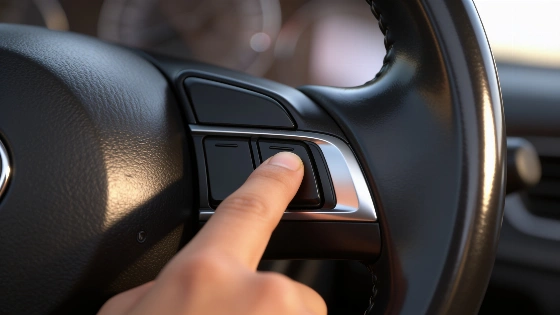
ACC does not take over for the driver. FDM stresses that drivers must stay alert, keep their hands on the wheel, and be ready to step in. The system can get confused by a merge, react too late, or miss something in a complex situation.
Much of the trouble starts when drivers merge or change lanes. Cutting in too fast or with too little space can set off ACC’s automatic braking. That surprises everyone behind. The safest move is to signal early, check both gaps, and merge smoothly. Don’t slam the door. ACC users should expect others to merge and pick a following distance that fits the traffic.
This isn’t just about new cars. As reported earlier, Spain’s roads are still full of older vehicles. Many have no advanced driver aids. Old and new tech mix together. That makes traffic even less predictable.
ACC is not a magic fix for safety or traffic jams. It can make driving easier and safer, but only if drivers stay alert and drive with care. Spanish highways are filling up with old diesels and new cars packed with sensors. The real test is simple. Can drivers and machines share the road without turning every merge into a chain of sudden stops?