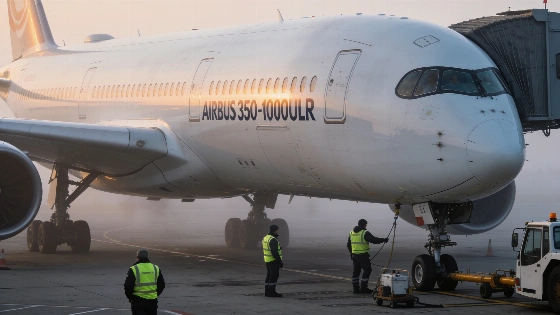
The Airbus A350-1000ULR has completed a 24-hour, 24-minute test flight from Melbourne to Toulouse, covering 12,460 nautical miles. Qantas aims to launch direct Sydney-London flights in October 2027, promising a new era for ultra-long-haul travel.
On July 28, 2026, the Airbus A350-1000ULR completed a landmark test flight, spending 24 hours and 24 minutes in the air between Melbourne and Toulouse. The aircraft covered 12,460 nautical miles, pushing the boundaries of what is possible for commercial aviation and bringing Qantas one step closer to launching nonstop Sydney-London services.
This extended test was designed to evaluate the aircraft’s additional fuel tank, fuel management systems, and cabin comfort under real ultra-long-haul conditions. Airbus engineers monitored ventilation, temperature, and crew rest areas, while the plane carried five tonnes of test equipment and over 1,000 sensors to capture system performance. The mission was not a formal certification flight but a development milestone, ensuring the jet could handle the demands of flights lasting over 23 hours—well beyond the planned 21 hours and 40 minutes for the Sydney-London route.
Testing the Limits
The MSN707 test aircraft departed Toulouse for Melbourne on July 23, completing the outbound journey in about 20 hours. Four days later, it returned to Toulouse, setting a new endurance record for the program. The campaign began in June with shorter flights, gradually building up to this ultimate test. Airbus’s approach allowed for operational flexibility, including taxiing, holding, and potential diversions, all critical for real-world commercial service.
Inside, the A350-1000ULR features a rear central fuel tank holding around 20,000 liters, with a dedicated system to balance and transfer fuel during flight. The test also measured how the cabin environment and crew rest facilities would perform over such an extended period, a key factor for passenger and crew wellbeing on ultra-long-haul journeys.
What Passengers Can Expect
While the test flight lasted over 24 hours, Qantas plans to offer commercial services of up to 22 hours, with the Sydney-London route expected to take about 21 hours and 40 minutes. The extra time in testing provided a safety margin and allowed Airbus to gather data beyond what passengers will experience. The aircraft will be reconfigured for commercial use after the test campaign, removing the specialized equipment and sensors.
Qantas’s new A350-1000ULR fleet will feature 238 seats across four classes, with more than 40% dedicated to premium cabins. Passengers can expect a wellness zone, circadian lighting, and dedicated crew rest spaces. The airline has ordered 12 of these jets for its Project Sunrise initiative, with the first aircraft, named Vega, set for delivery in April 2027. Tickets for the Sydney-London route are scheduled to go on sale in February 2027, with daily flights beginning in October. A direct Sydney-New York service is also planned, though its launch date remains unconfirmed.
Not the First, But the Furthest
Although the A350-1000ULR is not the first ultra-long-range Airbus in commercial use—Singapore Airlines has operated the A350-900ULR on nonstop Singapore-New York flights since 2018—it is set to become the longest regular commercial flight in the world. Airbus and Qantas emphasize that the aircraft is not designed to connect every city pair on the planet without stops, but its range and efficiency mark a significant leap forward. The A350 family is credited with 25% lower fuel consumption and emissions compared to previous-generation aircraft, though this figure applies to the entire family rather than direct comparisons with one-stop alternatives.
Preparing for Takeoff
Qantas has already opened a new training center in Sydney to prepare more than 360 pilots and 1,200 cabin crew for the arrival of the A350-1000ULR. The airline expects the new nonstop route to cut up to four hours from the fastest current one-stop connections, eliminating layovers and simplifying baggage transfers. However, existing routes via Singapore and the direct Perth-London service will remain, offering travelers more options rather than replacing all stopover flights.
As the aviation industry continues to push technological boundaries, the successful test of the A350-1000ULR signals a new era for ultra-long-haul travel. For those interested in other major engineering feats, a recent report on a controversial gold discovery in Extremadura also highlights how innovation and ambition are reshaping industries far beyond aviation.