Aitana closed her Barcelona tour with a direct message in Catalan, urging its use and reflecting on her own connection to the language. Her speech comes as new data shows Catalan’s declining presence in the region.
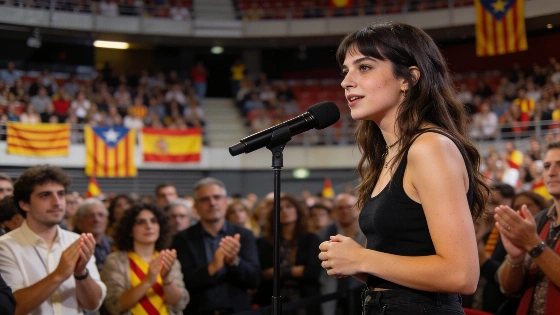
Aitana’s final Barcelona show at Palau Sant Jordi was more than a concert. She took the stage and, in Catalan, called the language Catalonia’s most important asset. Her words landed in a city where the future of Catalan is a live debate.
Raised in Sant Climent de Llobregat and educated in Catalonia’s public schools, Aitana addressed the crowd in Catalan. She shared that, although her family spoke Spanish at home, school gave her fluency in Catalan. She admitted her skills have faded after years away, a detail that struck a chord with many in the audience.
Aitana performed four sold-out concerts at Palau Sant Jordi in Barcelona, attracting a total audience of around 74,000 people.
Her speech wasn’t improvised. In the days before the show, she asked friends to speak Catalan with her so she could regain confidence. On stage, she explained that she wanted to honor her roots and the language of her childhood, even if it felt unfamiliar now.
The timing was pointed. The Generalitat’s 2023 Survey of Linguistic Uses found that only 24.7% of people in Barcelona’s metropolitan area now use Catalan exclusively in daily life. The drop has sharpened debate about the language’s future, especially in cities where Spanish is dominant. With five million followers and over 20 million monthly listeners, Aitana’s public support brought new attention to the issue.
Clips of her speech spread quickly on social media, drawing thousands of views and sparking discussion among fans. While she has used Catalan in public before, this was her most direct and sustained message yet. The crowd responded with applause, but the bigger conversation played out online, with reactions ranging from pride to concern about Catalan’s future.
Media outlets noted that Aitana's Catalan-language remarks were widely shared online, fueling debate among fans and the public. Her concert was seen as part of a broader resurgence of interest in Catalan music and culture in Barcelona.
During her address, Aitana encouraged the audience to seek out more Catalan-language culture. She mentioned the true crime series Crims by Carles Porta as a personal favorite and urged support for local media and content. Her call comes as Catalan artists and educators continue to defend the language’s place in schools and public life.
The Barcelona concerts closed one part of Aitana’s tour. She now heads to Madrid and Bilbao before taking her Cuarto Azul Tour to other cities in Europe and the Americas. Still, her Catalan message is likely to echo beyond Palau Sant Jordi, especially as language policy remains a flashpoint in Catalonia.
Recent events have put new focus on Catalan identity and its preservation. The death of Rosa Maria Duran, a key figure for Catalan exiles, was reported earlier and serves as a reminder of what is at stake. In this context, Aitana’s speech is more than a celebrity gesture. She used her platform to join a generational conversation about language and belonging in Catalonia. That a mainstream pop artist feels the need to defend Catalan on stage shows how urgent the issue has become, and how much the region’s cultural ground is shifting.