Alexander Zverev needed nearly four hours to defeat Lorenzo Sonego in a tense five-set match. Rain delays left several first-round matches unfinished. Other top seeds advanced, but Belinda Bencic suffered an early exit.
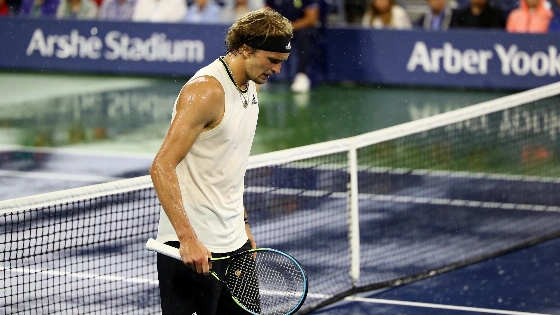
Day 3 of the 2026 U.S. Open ended with Alexander Zverev, the tournament’s top men’s seed, narrowly avoiding an early exit after a dramatic five-set struggle against Lorenzo Sonego. The match, played at Arthur Ashe Stadium, stretched close to four hours and was marked by momentum swings and relentless pressure from the Italian challenger. Zverev ultimately secured his place in the next round, but only after being pushed to his physical and mental limits.
Earlier in the day, the tournament schedule was thrown into disarray as persistent rain forced the suspension of play on the outer courts. Several first-round matches remain unresolved, creating a backlog that will require adjustments in the coming days. Despite the weather, key matches inside the main stadiums continued, with Taylor Fritz, Elena Rybakina, Mirra Andreeva, and Madison Keys all advancing. In contrast, Belinda Bencic, seeded 12th, was eliminated in three sets, adding to the day’s surprises.
Coco Gauff opened the night session with a commanding straight-sets victory, while Alexandra Eala and Gaël Monfils delivered late-night wins on Louis Armstrong Stadium, keeping the energy high despite the weather disruptions. The rain delays have left organizers with a challenging schedule, as matches will need to be rescheduled and players face the prospect of less recovery time between rounds.
After his marathon win, Zverev acknowledged the intensity of the contest, noting that it was one of the longest opening-round matches of his career. He credited Sonego for his level of play and suggested that overcoming such a demanding test could prove valuable for his confidence, especially after recent struggles in previous tournaments. The German’s ability to recover and adapt will be closely watched as the competition progresses.
The impact of weather on major sporting events is not new, and the U.S. Open has a history of adapting to such challenges. Organizers are expected to prioritize the completion of outstanding matches, with play set to resume at 11 a.m. ET on all courts except Arthur Ashe, where top matches will begin at 11:30 a.m. The need to catch up on the schedule may influence player performance and tournament dynamics in the coming days.
While the focus in New York remains on tennis, the broader world of sports continues to deliver unexpected results and strategic battles. For example, recent analysis from MotorLand Aragón highlighted how calculated victories can shape a tournament’s narrative. As the U.S. Open moves forward, the ability of players and organizers to adapt to changing conditions will be crucial in determining who advances and how the event unfolds.
The U.S. Open is one of the four Grand Slam tournaments and is known for its demanding schedule and unpredictable weather. Matches at Arthur Ashe Stadium are often played under a closed roof during rain, but delays on outer courts can disrupt the rhythm for both players and fans. The tournament’s outcome can have implications for player rankings and the broader tennis calendar, especially when early upsets or scheduling challenges arise. As the event continues, attention will remain on how top seeds manage the physical and mental demands of back-to-back matches and whether any new contenders emerge from the disrupted draw.