Alfonso Guerra reignited Spain’s debate over its recent past by openly defending Juan Carlos I and the spirit of the Transition. In Toledo, he joined Emiliano García-Page and Rodolfo Martín Villa to urge a return to political consensus.
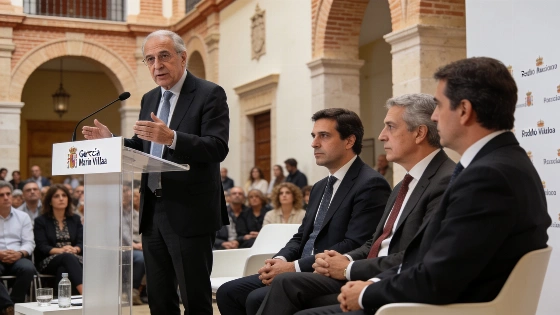
Alfonso Guerra stepped up to the microphone in Toledo and went straight to the point. The former Socialist vice president told the crowd that Spain’s democracy began when “a king receives all the power from a dictator and decides he does not want it.” With that, Guerra put Juan Carlos I back in the spotlight. He challenged the silence that now surrounds the former king. “Nobody wants to say it today because he hunted an elephant,” Guerra said. The elephant scandal still hangs over Juan Carlos I’s name.
The Museo de Santa Fe hosted the event. It marked the launch of the exhibition La Transición en Castilla-La Mancha. Guerra shared the stage with Emiliano García-Page, president of Castilla-La Mancha, and Rodolfo Martín Villa, former UCD minister. All three defended the spirit of consensus that shaped Spain’s Transition. That era is about to hit its 50th anniversary. Reports from Europa Press and other Spanish outlets say the exhibition brings together about 300 artifacts. It will stay in Toledo until October 25, 2026. After that, it will travel to other provincial capitals in the region through April 2027.
The exhibition in Toledo brings together approximately 300 items and will travel across Castilla-La Mancha after October 25, 2026.
García-Page did not hold back on his view of today’s politics. He called the Transition a “collective success.” He warned that current leaders “would not be up to the task” of making such deals. “They cannot even resolve minor deals, let alone something of this magnitude,” he said. García-Page drew a sharp line between the resolve of the post-Franco generation and the divisions he sees now. He admitted he finds it “almost impossible to imagine” a 50th anniversary celebration for the Constitution under current conditions. ABC and other Spanish media reported that García-Page sees even small agreements as out of reach for today’s politicians.
Guerra looked back at the choices made in the 1970s. “We cannot choose the time we live in, but we can choose our response,” he said. He remembered how people with “very different” views managed to agree on a constitutional text. Only six deputies out of 350 voted against it. But now, Guerra pointed out, just one of the parties that backed the Constitution still exists. He wondered if it would even vote yes today. El Confidencial reported that Guerra specifically doubted the current PSOE would support the Constitution as it did back then.
Martín Villa gave his own warning. He said Spanish politics is still haunted by the Civil War. “We play at being grandchildren of a Civil War that we all lost,” he said. He argued it is better to be “children of the Constitution.” In his view, if this were the Transition era, the prime minister would have called the opposition leader to talk. That kind of dialogue is rare now.
The debate in Toledo was timed to coincide with the 50th anniversary of the start of Spain's Transition, a period organizers and participants highlighted as a model of consensus and constitutional compromise in the 1970s. The event underscores how the legacy of Juan Carlos I and the Transition remains a point of political contention in Spain today.
The Toledo debate comes as Spain’s politicians face growing criticism for failing to reach consensus. The difference with the Transition era is clear. The country is about to mark fifty years since the end of dictatorship. The exhibition stands as a reminder of the risks and determination that shaped Spain’s path to democracy.
Recent resignations, like those reported earlier in Ceuta, show how unstable and tough leadership is in Spain right now. The longing for the Transition’s spirit is not just about the past. It is a sharp critique of the present.
What comes out of Toledo is not just a defense of Juan Carlos I or nostalgia for a lost era. It is a reminder that Spain’s democracy was built on unlikely alliances and a willingness to put aside old fights for the common good. As the 50th anniversary of the Constitution approaches, Guerra, García-Page, and Martín Villa send a clear message. The real test for Spain’s leaders is whether they can recover even a bit of that old determination and vision. The lesson of the Transition is not nostalgia. It is a challenge to today’s politicians to rise above division and rediscover the value of real consensus.