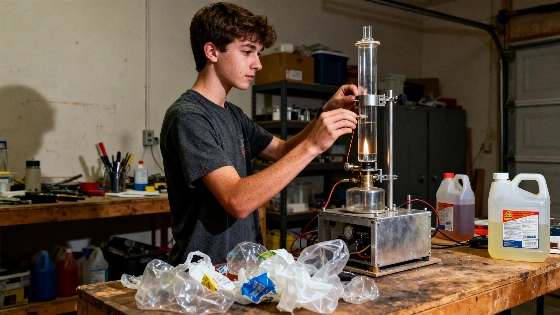
American Student Creates Device That Turns Plastic Waste into Fuel. A young inventor from the US has developed a prototype capable of converting used plastic into liquid fuel using microwave pyrolysis. The technology appears promising but requires independent testing and further refinement before it can be widely adopted.
In Atlanta, 19-year-old Julian Brown assembled an experimental apparatus capable of converting used plastic bags and packaging into liquid fuel with properties similar to gasoline, diesel, and aviation kerosene. The key to the process is pyrolysis using microwave heating, which allows the plastic to break down into shorter hydrocarbon chains in the absence of oxygen.
Brown began working on the project as a teenager, teaching himself chemistry and conducting experiments at home. His goal was not the mass production of fuel, but to test the possibility of controlled plastic decomposition. Unlike traditional pyrolysis, where the material is heated by external sources, this method uses microwave radiation, which, according to the inventor, increases the efficiency and controllability of the process. This requires a sealed chamber, precise temperature control, and a vapor extraction and condensation system.
Potential and Limitations
A video demonstrating the operation of the installation quickly spread across social networks, sparking interest in the idea of turning household waste into energy carriers. However, as Talent24h notes, there is a big gap between a spectacular demonstration and a technology ready for industrial use. The resulting liquid cannot always be used directly in engines: further purification and standardization are required. In addition, questions remain regarding safety, emissions, and handling of byproducts, especially when working with flammable vapors.
To move from a prototype to a complete technology, independent tests, repeatable experiments, strict safety protocols, and an environmental assessment are necessary. Currently, Braun is developing the project through the startup NatureJab and is seeking funding to professionalize the development. His task is not just to prove the concept works, but to confirm its safety and stability in practice.
Opportunities for waste recycling
If the technology passes all checks, it could become one of the solutions to the plastic waste problem, allowing some garbage to be converted back into fuel. However, experts emphasize that mass implementation will only be possible with transparent trials and proven environmental safety. Otherwise, the project will remain an intriguing experiment, but will not become a real tool in the fight against pollution.
Interest in new waste management methods is growing worldwide. For example, other unconventional approaches to household waste recycling have previously been discussed — as in the case of using coffee grounds and baking soda for cleaning. These initiatives show that the search for innovative solutions is becoming increasingly relevant amid rising amounts of waste and growing environmental demands.