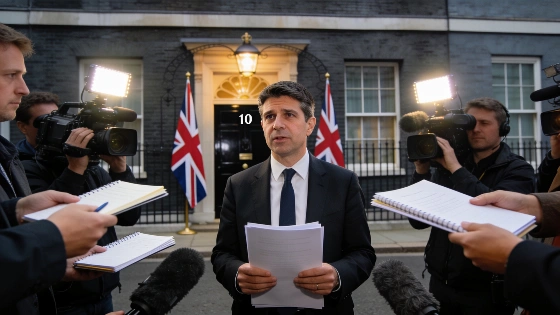
Andy Burnham, the UK’s new prime minister, has set out a 10-year strategy to tackle rough sleeping and overhaul the economy. His first speech focused on urgent action for housing, youth employment, and the cost of living.
Andy Burnham, newly appointed as the UK’s prime minister, has made the fight against rough sleeping a central priority in his first address after forming a government. Speaking outside Downing Street, Burnham committed to immediate action, stating that his first directive would be aimed at eliminating rough sleeping nationwide. This move signals a shift in government focus towards social issues and public welfare.
Burnham outlined a broader 10-year plan for Britain, promising to reshape the economy and address the ongoing cost of living crisis. He emphasised the need for structural changes, including reforms to the education system to support youth employment, expanded mental health services, and a significant increase in council housing construction. According to Burnham, these steps are intended to reduce welfare spending in a sustainable way while maintaining fiscal discipline and meeting international defence commitments.
The prime minister also highlighted the importance of building a more preventative state, with investment directed at supporting people’s success rather than managing failure. He described his government as a “circuit breaker” for the country, aiming to deliver the most significant changes in four decades. Burnham criticised past policies that centralised political power and privatised economic assets, arguing that many regions have yet to recover from deindustrialisation and still feel left behind.
In his speech, Burnham promised to decentralise authority, giving local communities more control and responsibility. He argued that returning essential services to stronger public oversight would help make basic needs more affordable. The prime minister also acknowledged the political instability of recent years, noting that he is the sixth person to assume the role in a decade. He called for a new approach to politics, focused on collaboration and practical problem-solving rather than partisan competition.
Burnham announced that proposals to ease the cost of living would be unveiled the following day, with details on funding to be provided. He stressed the urgency of providing immediate relief to households facing financial pressure, while also laying out a long-term vision for national renewal. The speech concluded with an appeal for unity and a renewed sense of hope, as Burnham pledged to put the care of people at the centre of government policy.
For context, the UK has faced persistent challenges with homelessness and rising living costs over the past decade. According to official statistics, rough sleeping in England increased sharply in the late 2010s, prompting repeated calls for comprehensive government intervention. Previous initiatives have struggled to deliver lasting results, often hindered by funding constraints and policy fragmentation. Burnham’s approach, combining immediate directives with a decade-long strategy, marks a notable attempt to address these issues at both the systemic and practical levels. The effectiveness of these measures will depend on sustained political will, cross-party cooperation, and the ability to translate ambitious plans into concrete outcomes for those most affected.