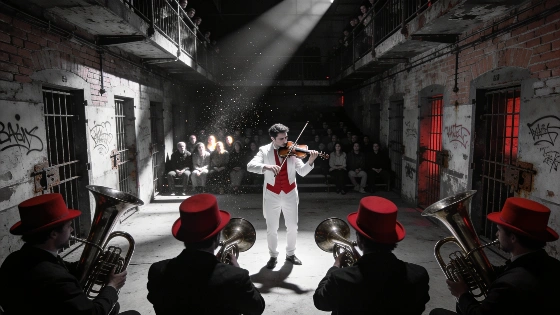
Barcelona’s La Modelo prison hosted an experimental concert led by violinist Asia. The event honored late Franco-era inmates who once played Bach on an out-of-tune piano. The performance reimagined the prison as a space for memory and sound.
Barcelona’s historic La Modelo prison, long a symbol of repression, was recently transformed into an unexpected concert venue during the Grec Festival. Violinist Asia led a striking musical tribute inside the former penitentiary, honoring the late Franco-era prisoners who once filled its halls with the music of Bach, played on a battered piano. The event reinterpreted the prison’s charged atmosphere, blending memory, architecture, and sound in a way that challenged the building’s punitive legacy.
The performance drew inspiration from a pivotal moment in 1973, when Pere Portabella and Carles Santos were detained in La Modelo. Portabella encouraged Santos to reinterpret Bach on an out-of-tune piano, a conceptual act that sought to reclaim the prison space through music. Decades later, Asia’s concert-action echoed this gesture, using the very galleries where those events unfolded. The audience was positioned in the prison’s panopticon, a space once designed for surveillance, now repurposed as a stage for artistic expression.
The evening began with a percussionist moving through the galleries, striking doors, walls, and bars with drumsticks. The sounds reverberated through the corridors, turning the prison’s architecture into a resonant instrument. The performer’s visible exhaustion and focus heightened the sense of tension, before he took his place at a drum set in the center of the panopticon. This gradual build-up led the audience through barred gates into another gallery, where the main ensemble awaited.
At the heart of the action, eight tuba players in matching attire and red bowler hats sat on platforms, facing Asia, who stood out in white and red. The arrangement evoked a static procession, a visual metaphor for the enforced immobility of prison life. The music unfolded in seven movements, with the deep, majestic tones of the tubas—an homage to Carles Santos, known for his use of brass ensembles—contrasting with the sharp, agile lines of Asia’s violin. The interplay of high and low registers filled the gallery, the open cells allowing the sound to seep into every corner, reinforcing the idea that space itself can become an instrument.
Throughout the 55-minute performance, the audience experienced a fusion of memory, unease, and fleeting beauty. Some spectators lay on the floor, watching as leaflets reminiscent of a prison uprising drifted down from above. The unpredictable rhythms and shifting harmonies conjured a sense of both confinement and transformation, recalling a time when, while the streets outside played "Algo más" by Camilo Sesto, inside La Modelo it was Bach—albeit out of tune—that resonated.
This event is part of a broader trend of reimagining historical sites through art and performance. Similar projects, such as David Byrne’s "Playing The Building," have turned architecture into musical instruments, while Ryuchi Sakamoto’s use of a damaged piano after the Tohoku disaster paid tribute to resilience and imperfection. The transformation of La Modelo for the Grec Festival highlights how spaces marked by history can be reclaimed for collective memory and creative expression. In a related context, public reactions to controversial reinterpretations of the past have sparked debate elsewhere, as seen when Claudio Savoia’s remarks on the Malvinas War drew widespread attention in Argentina.
La Modelo, once a site of punishment and silence, now stands as a testament to the power of art to reshape narratives. The concert not only honored those who endured its walls but also invited new ways of listening to spaces heavy with history. As cultural events continue to find footing in unconventional venues across Spain, the boundaries between memory, place, and performance are being continually redrawn.