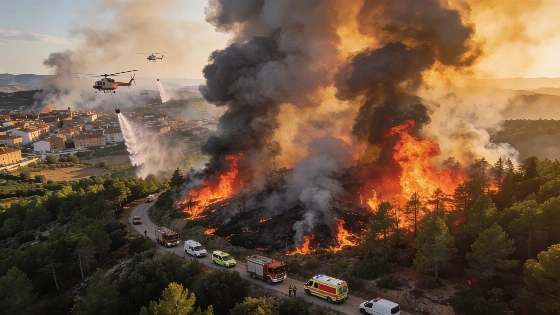
Spain’s government declared its highest wildfire emergency in response to the massive blaze in Burgohondo, Ávila province. Around 11,000 residents were forced to evacuate, and several towns were placed under strict confinement. Classified as Situación Operativa 3, the fire was initially estimated to have burned between 13,000 and 15,000 hectares, with a containment perimeter stretching approximately 71 kilometers. A later report citing data from Spain’s Ministry for the Ecological Transition and the Demographic Challenge put the final burned area at 33,943 hectares. The fire was officially declared extinguished on October 3, after about 73 days of response and monitoring. The Ministry of the Interior, supported by the Unidad Militar de Emergencias (UME), led the response after authorities activated the national-level emergency for the first time in a forest-fire scenario.
Authorities ordered evacuations in more than a dozen municipalities, including Burgohondo, Navaluenga, and El Tiemblo. More than 8,000 people in El Tiemblo were confined to their homes. Additional towns affected as of Saturday included Piedralaves, La Adrada, Sotillo de Adrada, Casillas, Santa María del Tiétor, Navahondilla, Navahonda, and Casavieja. These areas joined Villanueva de Ávila, Hoyo de Pinares, and the La Atalaya urbanization in El Tiemblo, information from Nicanor Sen, the government delegate for Castilla y León. Reuters reported that sparks from heavy machinery near Burgohondo ignited the fire, and strong winds drove its rapid growth.
Emergency services kept the fire’s progress under constant surveillance and urged residents to follow official instructions. Protective measures could change quickly as conditions shifted. The operation drew on resources from the Junta de Castilla y León, the Ministry for the Ecological Transition and the Demographic Challenge, UME, local councils, provincial authorities, Civil Protection, and reinforcements from other autonomous communities. The deployment included helicopters, coordination and firefighting aircraft, forest brigades, fire engines, heavy machinery, and more than a hundred UME personnel.
The consequences continued after the fire was extinguished. In October, rainfall washed ash into water intakes in the Valle del Tiétar, leaving water black and unsuitable for consumption in Casavieja, Piedralaves, and Mirajes. More than 4,000 people were affected, RTVE reported. Casavieja faced the most serious conditions; municipalities adjusted their intakes while awaiting laboratory analyses, and the Junta de Castilla y León worked to restore supply. On October 23, the regional government announced €600,000 for restoration of land affected by the fire. Separately, concerns emerged about pests developing in fire-killed timber in Piedralaves. Inforcyl data cited by Diario de Ávila put the area destroyed by Burgohondo and other major Castilla y León fires at 33,943 hectares combined, 81% of it forested or tree-covered.
The response also drew political scrutiny. Socialist regional legislator María del Carmen Iglesias said the Junta had been “overwhelmed by the Burgohondo fire,” criticizing its actions before, during, and after the emergency. Environment and Energy Minister María González Corral defended the regional response, saying it had pursued “rapid and effective solutions,” including restoring drinking-water supplies. She also questioned the measures taken by Spain’s central government.
The fire came amid a series of severe wildfires across central Spain, with mass evacuations and emergency measures reported in other regions. A related report detailed a previous large-scale evacuation in Madrid province, where extreme weather and multiple blazes forced thousands from their homes: Madrid’s wildfire crisis and its impact on local communities.
The Burgohondo blaze was part of a wider European wildfire crisis that Reuters linked to rural depopulation and the buildup of combustible vegetation. Its effects stretched from evacuations and burned forest to damaged water infrastructure and timber, with publicly funded recovery also underway. The scale of the emergency exposed the vulnerability of rural and forested areas to fast-moving fires and the need to coordinate firefighting with longer-term field management. Residents in affected areas were urged to follow official updates and prioritize safety as response and recovery measures continued.