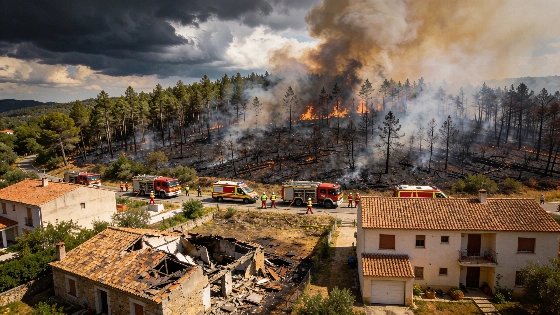
The lockdown in eight Girona municipalities has ended after the Les Gavarres wildfire was stabilized. Over 2,300 hectares burned, with homes and businesses damaged. Fire crews remain on alert due to high temperatures.
Authorities in Catalonia have ended the lockdown for eight municipalities in Girona following the stabilization of the wildfire that swept through the Les Gavarres natural park. The fire, which scorched 2,300 hectares, forced residents to remain indoors and restricted access to affected areas. With the situation now under control, locals are permitted to leave their homes, while those living within the fire perimeter can return under police supervision.
Firefighters declared the blaze stabilized overnight, but warned that the risk remains high due to soaring temperatures and the possibility of new outbreaks. Emergency teams are maintaining a strong presence in the area, prepared to redirect resources if fresh fires erupt elsewhere in Catalonia. According to Jordi Marín, head of the Girona fire brigade, some restrictions persist for properties inside the fire perimeter, and access will be coordinated with police forces.
More than 500 personnel—including firefighters, the Military Emergency Unit (UME), volunteers from the Agrupación de Defensa Forestal (ADF), and local farmers—worked through the night to contain the flames. The fire has left ten people with minor injuries, destroyed eight homes completely, and partially damaged another eight, along with several industrial buildings and vehicles on the fire's left flank.
Specialist teams are set to inspect the structural safety of affected buildings, particularly in the urbanizations of Cabanes (Calonge i Sant Antoni) and Vall Repós (Santa Cristina d’Aro). Aerial support is being reinforced with four water bombers and seven helicopters, as confirmed by fire service sources. The main focus remains on the fire's right flank, where the perimeter is highly irregular and dotted with secondary hotspots, complicating efforts to distinguish burned from unburned land.
Officials are concerned that midday sea breezes and persistent heat could reignite the fire, potentially pushing it deeper into the Les Gavarres massif and threatening up to 30,000 hectares. Road closures around the fire zone are expected to be lifted gradually, but authorities urge the public to avoid the area and refrain from 'fire tourism' to ensure emergency vehicles can move freely. Speed restrictions will be enforced on reopened roads to facilitate the work of response teams.
This incident follows a series of wildfires in Catalonia in recent years, highlighting the region's vulnerability during periods of extreme heat and drought. For context, a previous major blaze near La Bisbal d'Empordà also led to widespread lockdowns and significant firefighting challenges, as detailed in this earlier report on emergency measures in Les Gavarres. The current situation underscores the ongoing need for coordinated emergency response and public cooperation during wildfire season in Spain.
Wildfires are a recurring threat in Mediterranean regions, particularly during the summer months when high temperatures and dry conditions prevail. In Spain, the combination of climate change, land abandonment, and changing weather patterns has increased the frequency and intensity of such incidents. The Les Gavarres fire serves as a reminder of the importance of preventive measures, rapid response, and community awareness to minimize damage and protect both people and natural landscapes.