Catalonia has introduced a mobile unit to quickly restore mobile coverage in disaster-hit areas. The vehicle, equipped for 4G and 5G, aims to keep essential services running during outages. The measure follows the April 2025 blackout.
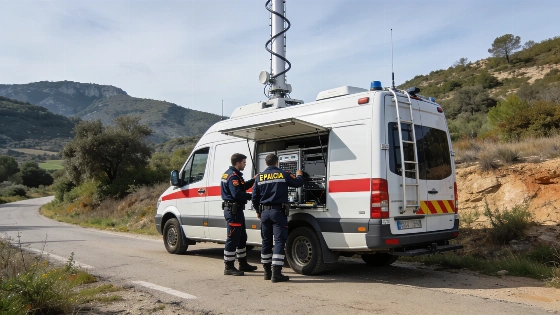
The Catalan government has launched Spain’s first mobile telecommunications unit designed to restore mobile phone coverage in areas hit by emergencies. The new vehicle, presented this week, is intended to ensure that essential services and public alerts remain operational when fires, storms or infrastructure failures disrupt regular networks. The move comes in direct response to the widespread blackout that struck the region in April 2025, exposing vulnerabilities in emergency communications.
Developed with a €422,500 investment, the vehicle is equipped to provide both voice and data services across 4G and 5G networks. It can connect to any available telecom tower or, if necessary, switch to satellite connectivity using Starlink technology. The system is designed for rapid deployment in rural or hard-to-reach locations, offering a coverage radius of 10 to 20 kilometers and up to 48 hours of autonomous operation thanks to its onboard generator.
Officials from the Generalitat, including Albert Tort, Secretary of Telecommunications and Digital Transformation, and Imma Solé, Deputy Director of Civil Protection, emphasized that the unit is not a replacement for existing infrastructure but a temporary solution to bridge gaps during crises. The project is the result of a public-private partnership involving the Generalitat, Telefónica, Vodafone, and MasOrange, aiming to reinforce the resilience of Catalonia’s communications network.
During emergencies such as wildfires, where flames can destroy cables and towers, the mobile unit acts as a repeater, restoring connectivity for both residents and emergency teams. This ensures that official alerts, including ES-Alert notifications, can still reach affected populations and that coordination among first responders is maintained. The importance of such measures was highlighted recently when authorities had to send emergency alerts to mobile phones during a wildfire near Senet, which led to the closure of mountain routes and was covered in detail in this report on emergency restrictions in the Pyrenees.
The Generalitat plans to keep the unit operational throughout the year, with an initial focus on the high-risk summer season. Future adjustments to the service will depend on operational needs and incident frequency. The budget covers not only the vehicle and generator but also ongoing deployment, operation, and monitoring services.
Spain’s geography, with its mix of urban centers and remote rural areas, makes reliable mobile coverage a persistent challenge during disasters. The new Catalan initiative reflects a broader trend in Europe to invest in resilient infrastructure capable of withstanding extreme weather and technical failures. According to official data, mobile networks are increasingly critical for both public safety and daily life, especially as more emergency alerts and coordination rely on digital platforms. The deployment of this mobile unit marks a significant step in Catalonia’s efforts to safeguard communications and public safety in the face of growing climate and infrastructure risks.